Have you ever tried executing a multidisciplinary simulation project only to find yourself trapped in workflow hell? You export a mesh from one application, battle file translation errors in another, and then realize your local workstation lacks the CPU cores to run transient FEA while CFD runs in the background. If that sounds painfully familiar, you are not alone. Engineering teams across automotive, aerospace, and industrial machinery struggle daily with fragmented simulation toolchains.
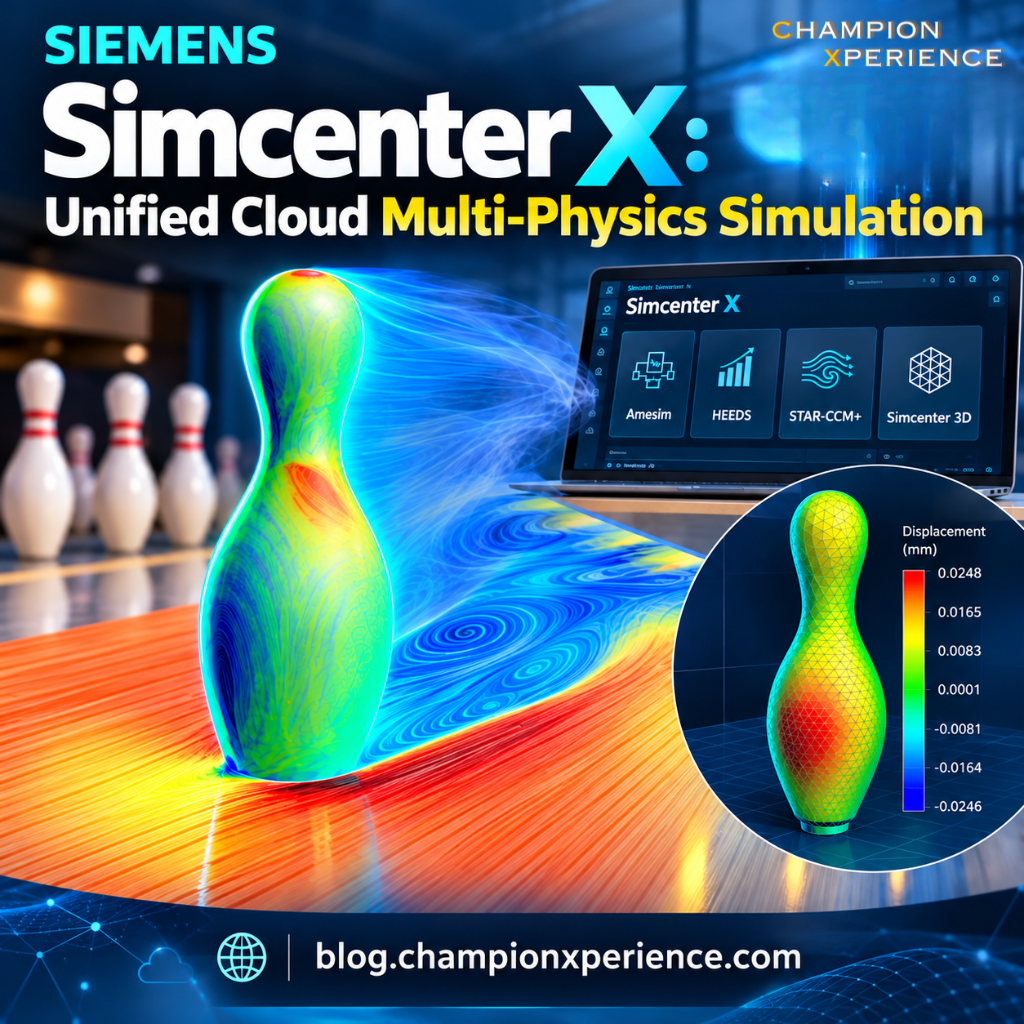
Siemens is tackling this exact challenge head-on. By unifying 1D system dynamics, computational fluid dynamics (CFD), finite element analysis (FEA), and design exploration into a single cloud-native Software-as-a-Service (SaaS) platform called Simcenter X, engineers can now execute full-spectrum multi-physics analysis without switching tools or juggling vendor licenses. To prove the platform’s versatility, Siemens recently published a comprehensive multi-physics demonstration centered around a surprisingly complex dynamic event: engineering the perfect bowling strike Siemens Simcenter Blog.
In traditional engineering environments, verifying a complex product requires stitching together disparate applications. A system dynamics model runs in one program, thermal or fluid behavior in another, and structural shock analysis in a third. Each application comes with its own user interface, proprietary file formats, and fixed workstation licensing. This friction slows down innovation and restricts advanced multi-physics verification to late-stage design phases when changes are exponentially expensive.
As cloud computing redefines industrial software , modern CAE platforms must eliminate infrastructure barriers. Cloud-native simulation enables teams to scale computing resources dynamically, execute simultaneous multi-domain solves on high-performance computing (HPC) clusters, and collaborate on unified data models in real time .
Simcenter X brings Siemens’ heavy-hitting simulation solvers under a single, cloud-accessible umbrella within the Siemens Xcelerator portfolio . Built on cloud architecture hosted on AWS, it delivers instant access to high-performance computing, central data management, and flexible token-based licensing .
Instead of purchasing standalone licenses for individual tools, engineers can access solvers on demand using shareable cloud tokens . Whether you need a 1D system dynamics run in the morning, a 100-core CFD burst at noon, or transient structural FEA in the afternoon, Simcenter X allocates the exact compute hardware and software entitlement you require instantly.
To demonstrate the practical power of this unified cloud workspace, Siemens engineers modeled an entire bowling game. While bowling sounds simple on the surface, the physical dynamics involved mirror the complex interactions found in robotics, automotive safety testing, and turbomachinery.
The journey begins on the lane. Using Simcenter Amesim and its 3D Mechanical Library, engineers constructed a full 1D/3D system dynamics model representing the bowling ball’s movement. The model computes key physical phenomena, including:
To make the simulation interactive, the team built a custom Python dashboard on top of the backend Simcenter Amesim model, enabling real-time input tweaking and instant 3D visual feedback.
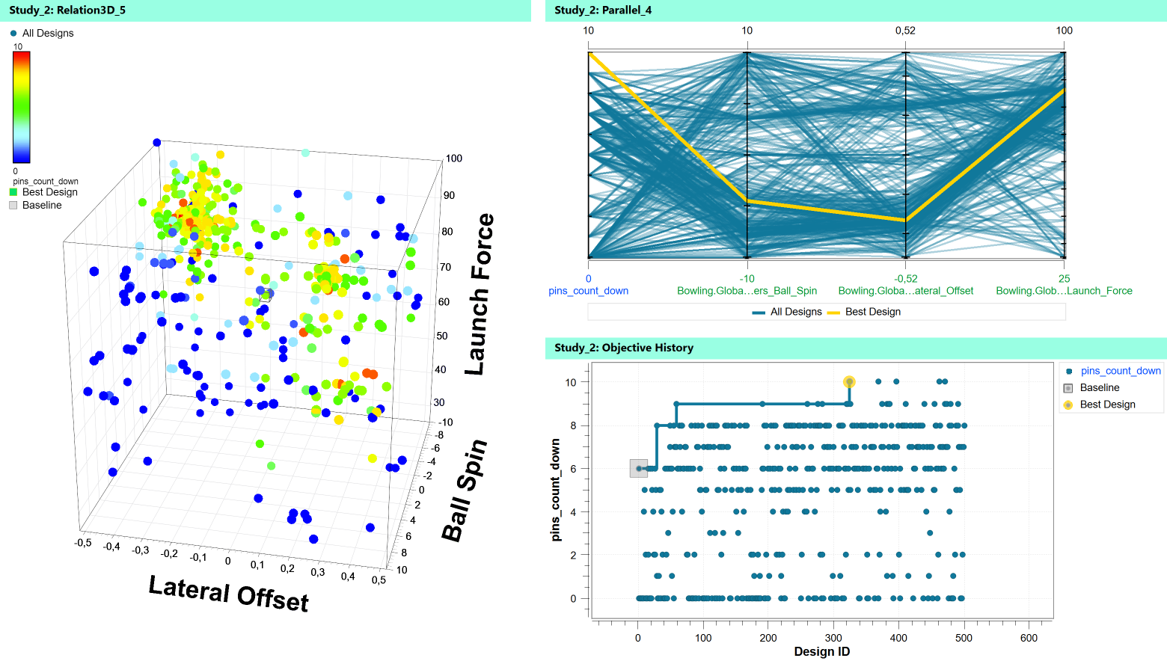
How do you guarantee a strike every single time? Manual parameter tweaking in CAD or CAE is time-consuming and prone to trial-and-error bias. That is where Simcenter HEEDS comes in.
Simcenter HEEDS automates design exploration by orchestrating hundreds of trajectory permutations. It searches across launch velocity, hook RPM, release angle, and lane oil gradients to locate the precise combination required for maximum pin destruction. Thanks to cloud-native orchestration in Simcenter X, running multi-variable optimization loops requires zero local hardware lockups.
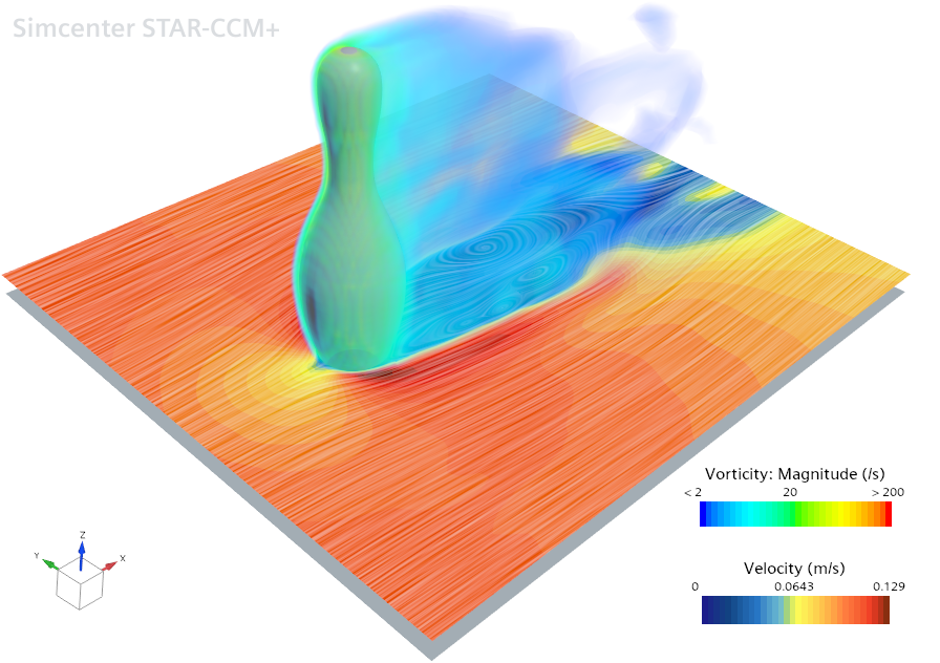
Moving beyond trajectory dynamics, the study dives into fluid-structure interactions. Using Simcenter STAR-CCM+ directly in the cloud virtual desktop environment , engineers ran high-fidelity Computational Fluid Dynamics (CFD) analysis on maplewood bowling pins.
The solver maps out air resistance, drag coefficients, and wake turbulence patterns as pins tumble through the air at high speed. The ability to launch Simcenter STAR-CCM+ on cloud HPC clusters on demand allows engineers to resolve complex turbulent structures without waiting in IT queues for hardware allocation.
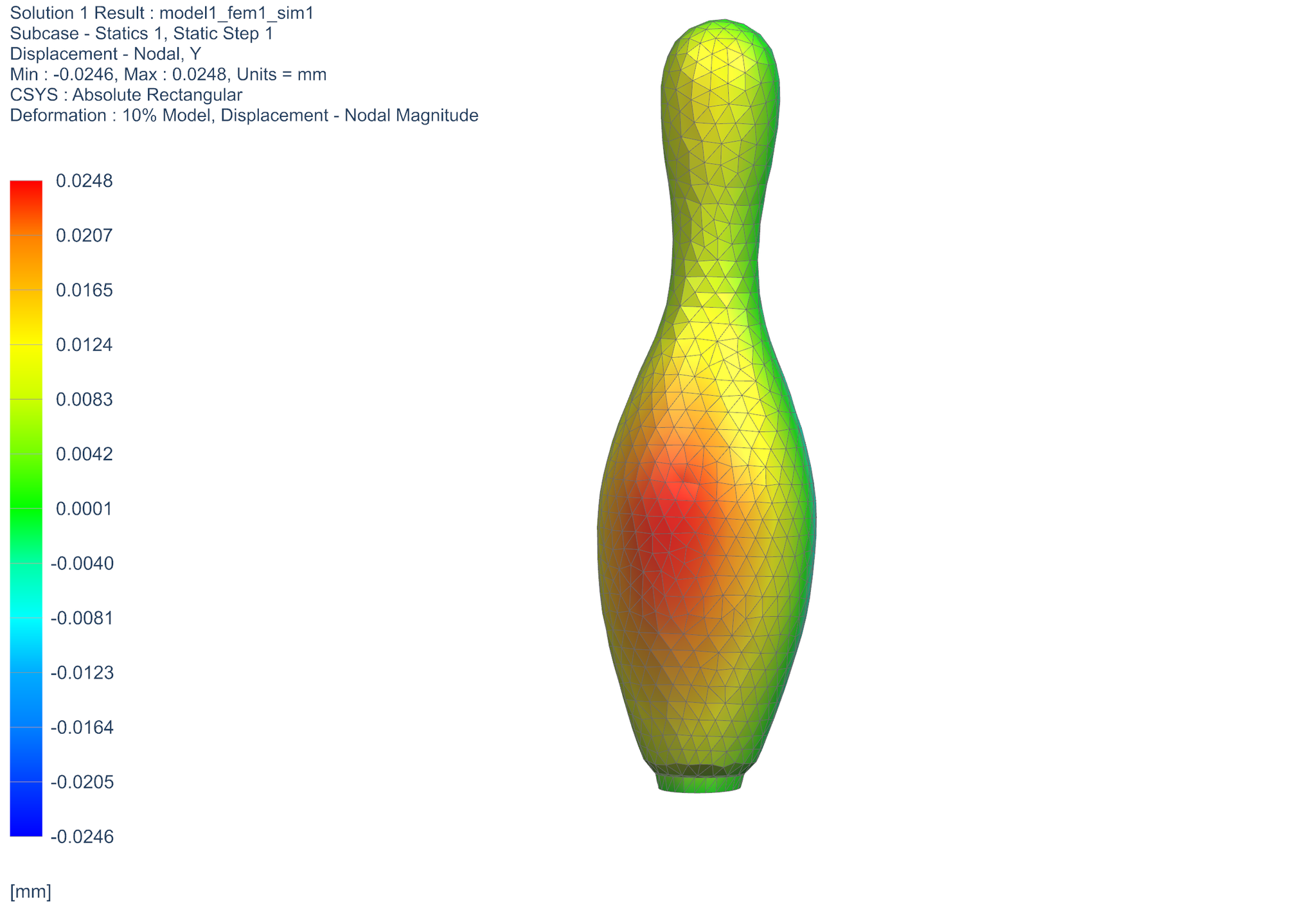
Finally, what happens inside the wooden core of a pin during impact? Using Simcenter 3D driven by the industry-standard Simcenter Nastran FEA solver, the team performed transient dynamic contact analysis.
The structural simulation reveals internal shockwaves, dynamic stress distribution gradients, and material deformation occurring during high-velocity impacts. This dynamic stress mapping illustrates exactly how mechanical components endure cyclic shock loads—crucial insight for product longevity in aerospace and defense applications.
To highlight why cloud-native multi-physics platforms are replacing legacy software setups, let’s break down the key operational differences:
| Capability / Metric | Traditional Local CAE Setup | Siemens Simcenter X Platform |
| Tool Integration | Isolated desktop apps with manual file transfers | Unified multi-physics suite sharing data natively |
| Licensing Model | Perpetual/annual fixed seats per solver module | Flexible cloud tokens and SaaS entitlements |
| Compute Scaling | Bounded by local RAM, GPU, and CPU core limits | Instant, elastic AWS cloud HPC scaling |
| Design Optimization | Manual scripting across separate applications | Automated multi-domain execution withSimcenter HEEDS |
| IT Maintenance | Heavy local installation, updates, and driver management | Zero-footprint web access and cloud desktop support |
While modeling bowling dynamics offers an entertaining demonstration, the underlying engineering workflow carries major implications for modern manufacturing. Whether you are designing automotive crash structures, optimizing aerodynamic drag on electric vehicles, or predicting stress fatigue in wind turbine blades, multi-physics problems demand connected analysis.
With platforms like Simcenter X, engineering organizations can strip away IT friction, lower enterprise licensing overhead, and allow analysts to focus strictly on physics and design trade-offs. The ability to jump from system-level 1D dynamics to high-fidelity 3D CFD and transient FEA under one platform marks a major milestone in cloud engineering.
Have you migrated any part of your CAE workflow to cloud HPC yet, or are local hardware constraints still holding back your simulation projects? Share your experiences in the comments below!
This guide is based on insights from the official Siemens Blog.