In this project, we model and analyze the crushing behavior of a thin-walled aluminum energy absorber under axial compression. The goal is to evaluate its deformation response and energy absorption capability, which are key factors in crashworthiness design.
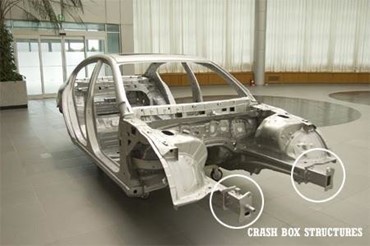
Energy absorbers, also known as crash boxes, play a critical role in vehicles. During a crash, they absorb most of the impact energy, protect the chassis from damage, and, most importantly, ensure passenger safety. In the figure below, we can see an example of crash boxes in a vehicle chassis.
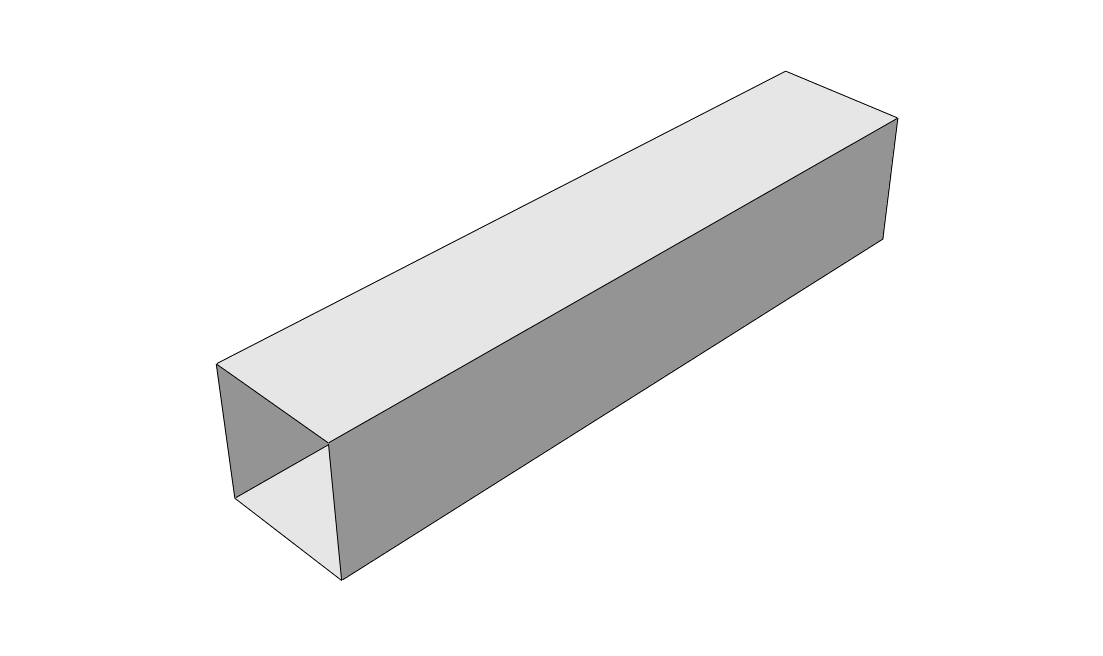
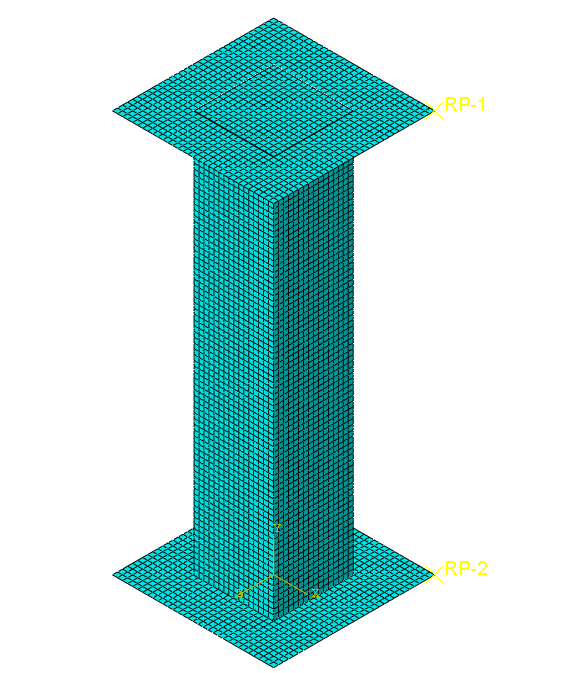
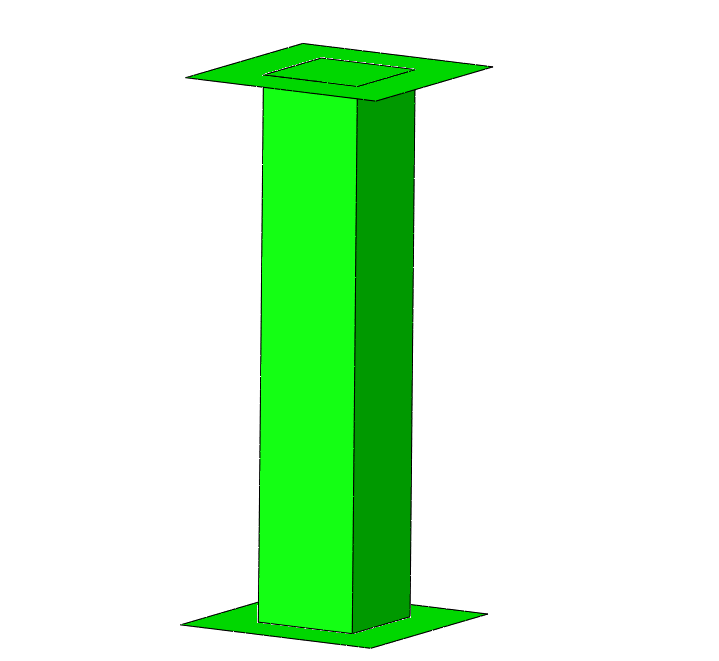
We model the energy absorber as a thin-walled box with an 80 × 80 mm square cross-section and a height of 400 mm. We represent the structure as a shell part using shell extrusion.
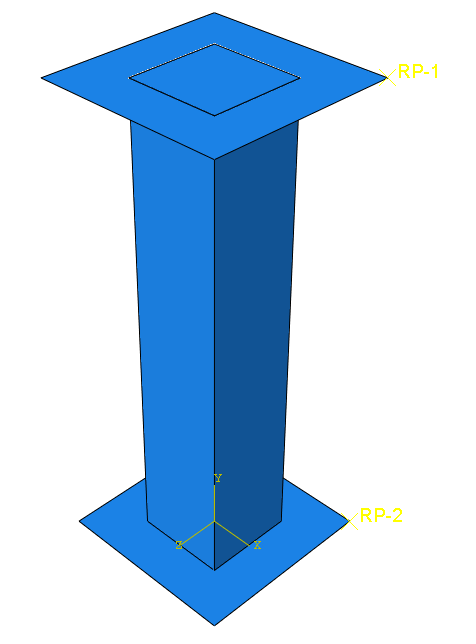
Two discrete rigid planar shells, each measuring 160 × 160 mm, represent the rigid plates. The simulation places the box between these plates and applies crushing by moving the top plate downward onto the structure.
Note: In Abaqus, rigid parts require a reference point to calculate reaction forces. This reference point must be defined in the part module, not in the assembly. Since we use the explicit solver here (explained below), inertia should be assigned to the reference points. The exact value of inertia doesn’t affect reaction forces.
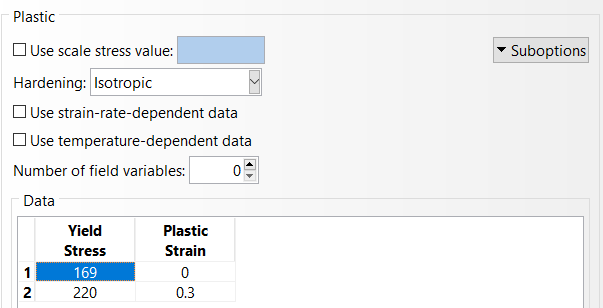
We use 2011 Aluminum for the energy absorber, with these key properties:
Young’s modulus: 71.7 GPa
Poisson’s ratio: 0.333
Yield stress: 169 MPa
Density: 2700 kg/m³
Plastic behavior is modeled as linear.
The shell thickness is set to 2 mm with the offset on the mid-surface.
For this analysis, we choose the Dynamic Explicit solver. Unlike the implicit solver, explicit solver takes inertia forces into account, and it also utilizes a different method for solving the matrix equations. The explicit solver calculates the response using many small, discrete time increments and advances step by step until the simulation ends. Engineers typically use explicit solvers to simulate large deformations, complex contact interactions, high loading rates, or material failure.
Because of the presence of inertia forces, it’s important to define density in the material model, and also to assign inertia to rigid parts.
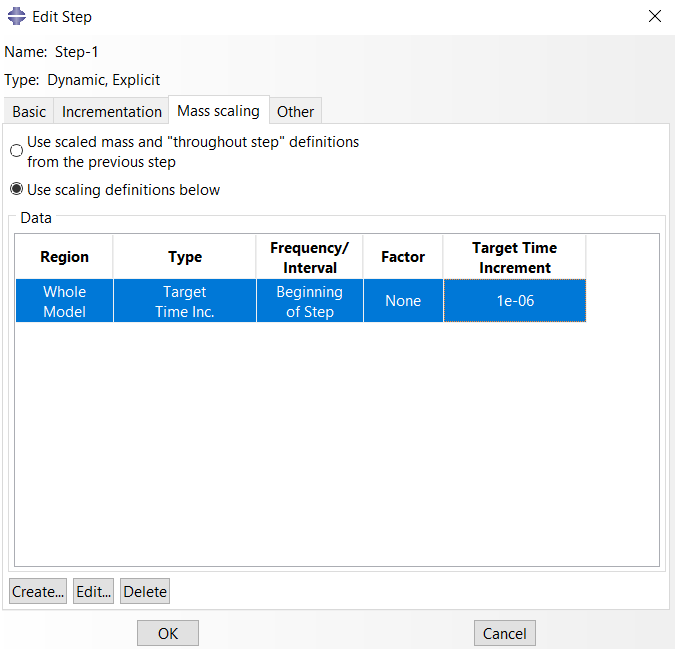
It’s also worth pointing out that Abaqus calculates the stable time increment based on the smallest element’s size and the wave speed (which is dependent to the material properties). The smaller the time increment, the longer it takes for the simulation to be completed.
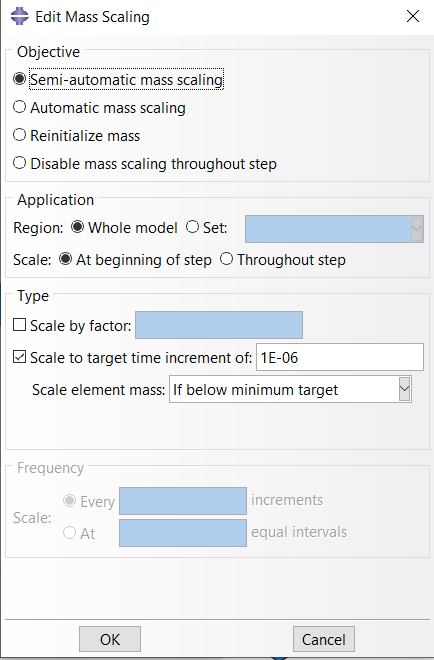
We apply mass scaling by artificially increasing the element mass, either through a direct mass scale factor or by defining a target time increment. Here, we use a target time increment of 1E-6s
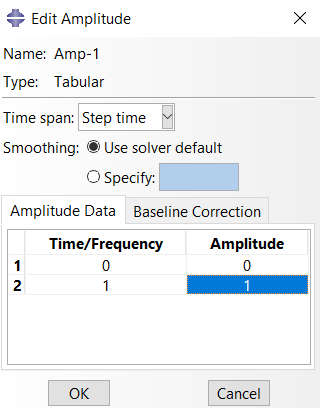
We pinned the box at the bottom. We applied a −300 mm displacement to the top plate (75% compression of the structure) in the y-direction while fixing all other degrees of freedom, and we fully fixed the bottom plate.
Note: when you specify a displacement in an explicit simulation, you should define an amplitude for how the displacement increases. In this project, we should use a linear increase in displacement, so we use tabular data.
For the interaction, General Contact was used.
Regarding the properties, tangential behavior with a friction coefficient of 0.4 and normal behavior with hard contact was considered.
A Seed size of 5 was considered and S4R elements were used.
S4R elements are 4 node shell elements with reduced integration.
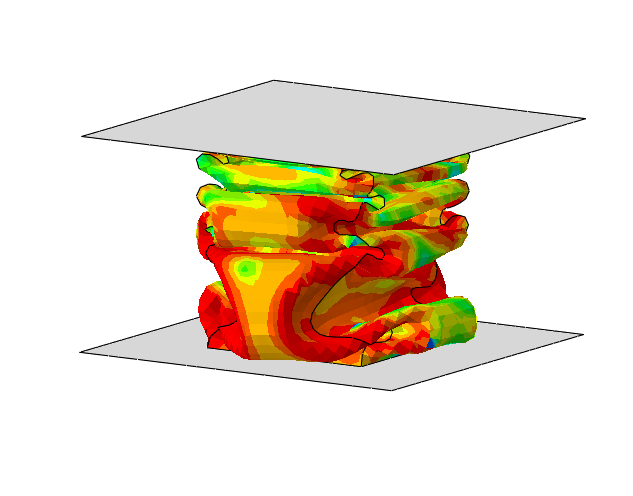
The figure below shows the crushed box after deformation
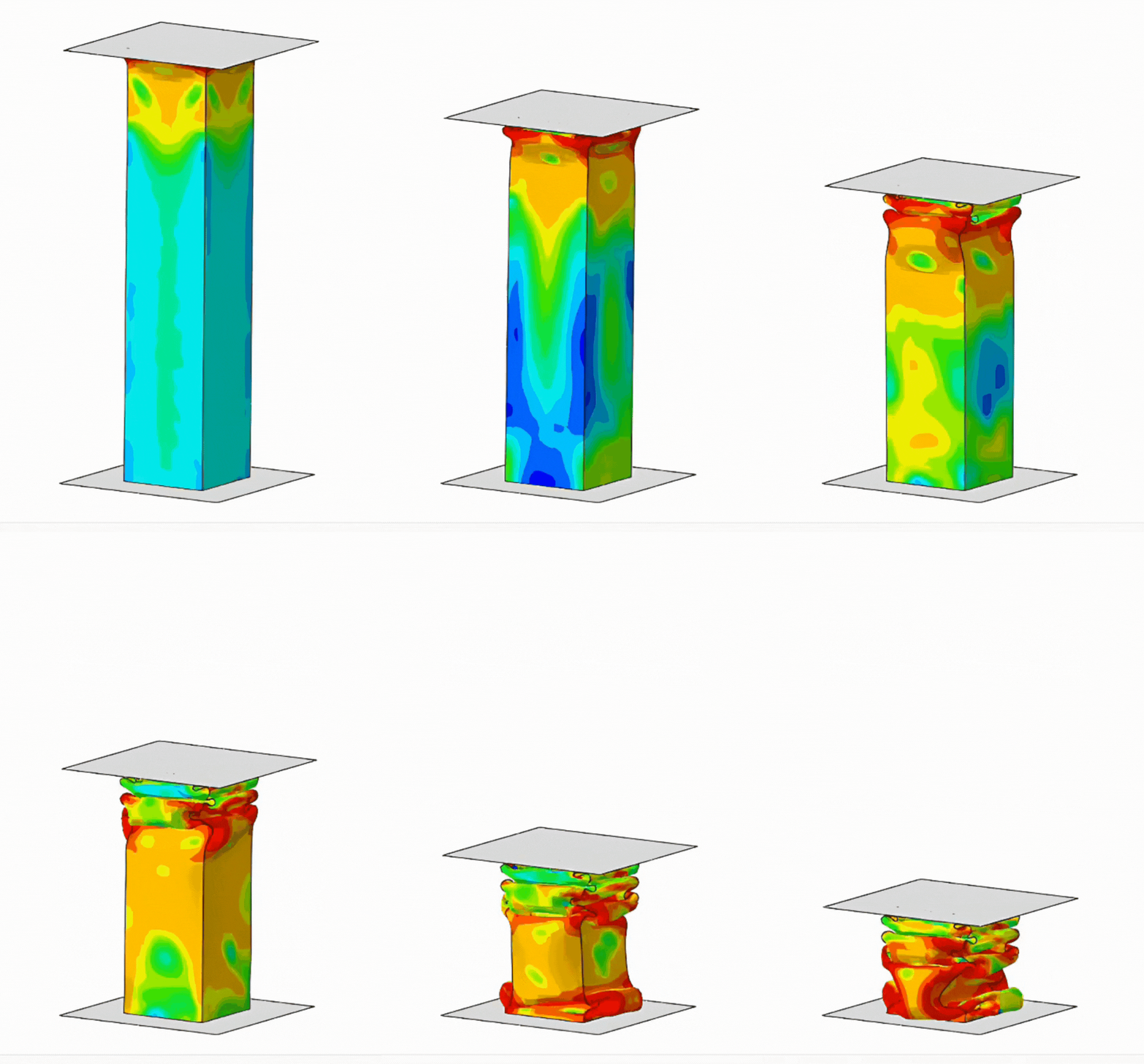
In the following animation, we can see how the box buckles as the top plate crushes it.
From the field outputs, we can extract forces and displacements. The force-displacement curve was plotted in excel.
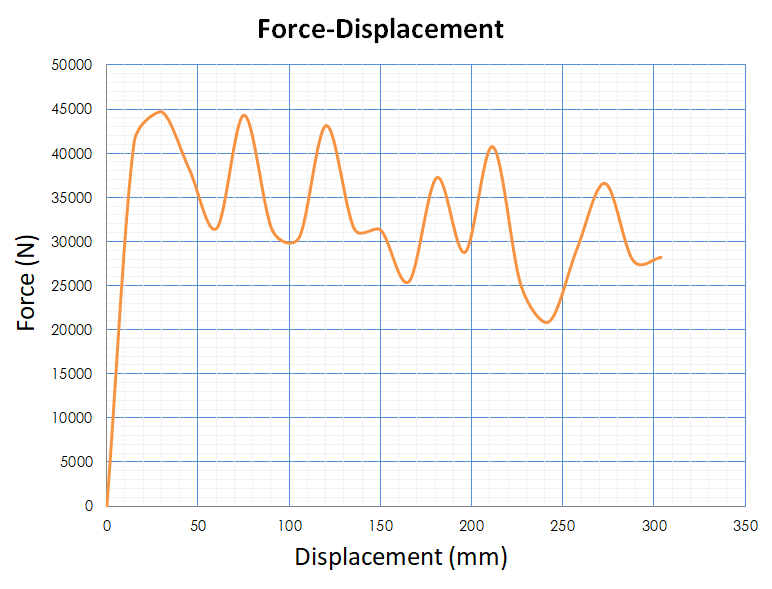
During crushing, the energy absorber initially reaches a peak force prior to yielding. The force then decreases slightly and fluctuates around a mean value, defining the plateau region of the force–displacement curve.
Each drop of force in the plateau region, correspond to a buckling in the column during crushing (as seen in the animation).
Regarding the performance of energy absorbers, there are a number of metrics used. two important metrics are Crushing Force Efficiency and Specific Energy Absorption.
During crushing, the energy absorber should limit the initial peak force to avoid excessive load transfer to the cabin and passengers. A high initial peak force increases the transmitted impact. An efficient energy absorber maintains crushing forces in the plateau region at levels comparable to the initial peak force, ensuring progressive energy absorption and improved passenger safety. The Crushing Force Efficiency (CFE) is defined as follows:
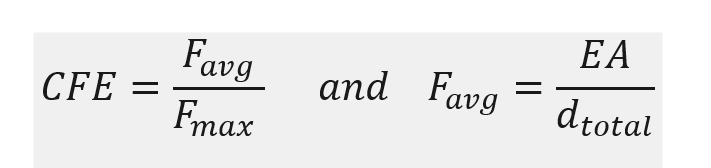
Fmax is the initial peak force, EA is the total absorbed energy and d-total is the total displacement during the crushing.
CFE values range from 0 to 1. A CFE of 0 shows the worst performance and a CFE of 1 shows the best.
Specific Energy Absorption determines if the structure is lightweight or not, and it’s defined as the following:
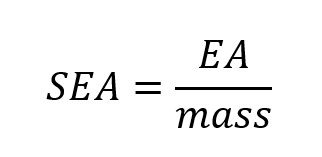
EA is again the total energy absorption, and mass is the total mass of the structure.
SEA value greater than 20 is acceptable and shows that the structure is lightweight.
How can we find these values from the force-displacement curve?
we already have the maximum force from the data we extracted from Abaqus. We only need to calculate the absorbed energy. The absorbed energy is basically the area under the force-displacement curve. Abaqus writes the output at a number of evenly spaced time intervals. The time interval can be specified in the field output options before submitting a job. The force displacement curve would actually look like the curve shown in the following figure.
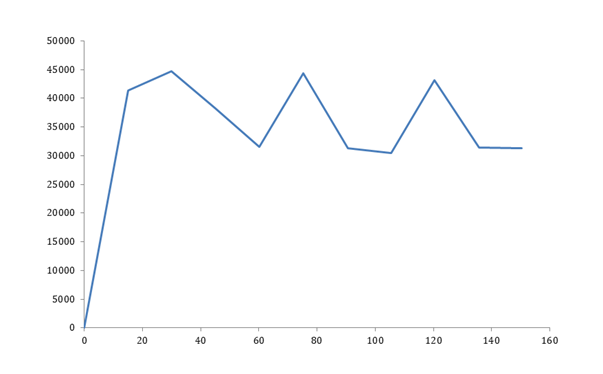
It’s possible to break the curve down to trapezoids. One trapezoid is shown in the figure below:
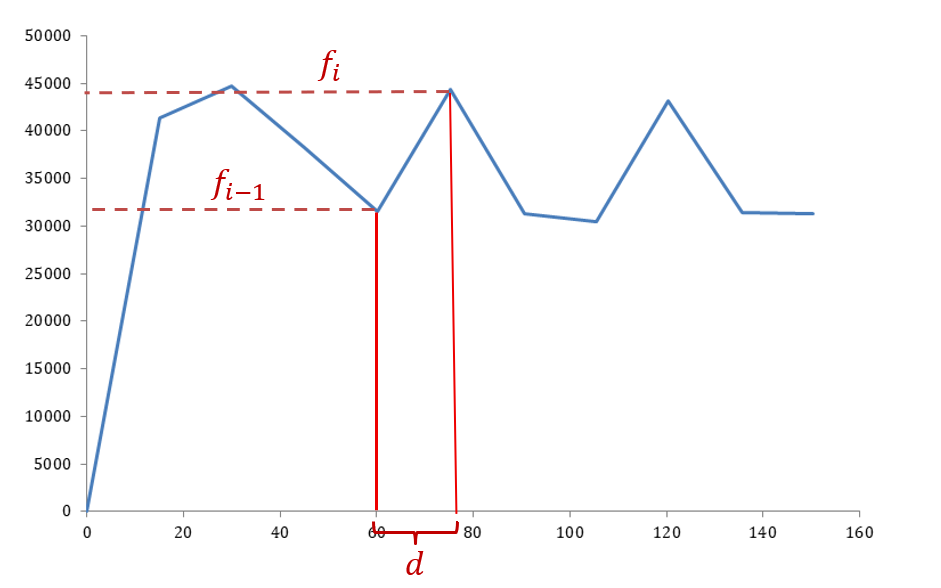
We can then simply calculate the area of each trapezoid and sum them to find the total absorbed energy. The formula can be written briefly as:
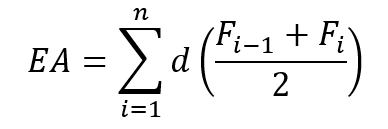
Where Fi is the force at the interval i, d is the displacement in each interval which could be found from the displacement data itself, or simply by dividing the total displacement by the number of intervals (it should be noted that in formula above,F0 is 0). For our case, we have a total displacement of 300 mm and 20 time intervals, which results in:

Therefore, we can calculate the total absorbed energy as:
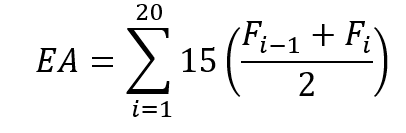
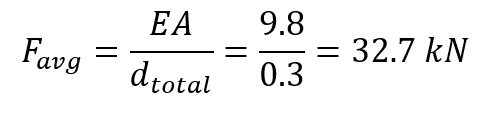
For our energy absorber, EA comes out as 9.8 kJ which is a good value for a light crash.
With a mass of 346 grams, we have:
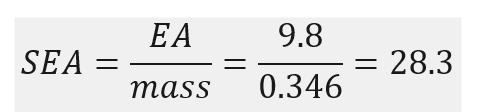
Which shows the structure is lightweight.
We can also calculate Favg as:
We can also calculate the Crushing Force Efficiency (CFE) to evaluate how smoothly the absorber manages impact energy.
With an initial peak force of 44.7 N, we can calculate the CFE:
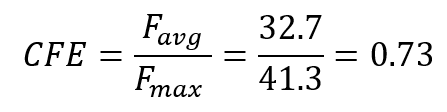
A CFE of 0.73 is acceptable and indicates that the structure absorbs most of the impact, ensuring passenger safety.
We successfully modeled and analyzed a thin-walled aluminum energy absorber’s crushing behavior using Abaqus’s explicit solver. The results showed acceptable performance values for both crushing force efficiency and specific energy absorption, indicating good energy absorption and passenger safety.
In real automotive applications, energy absorbers can be much more complex in both geometry and material. Using composite materials or special alloys and also utilizing honeycomb, lattice, or auxetic structures, or any other complex geometry optimized specifically for energy absorption, could significantly improve the performance of energy absorbers.