

Codebeamer AI helps engineering teams work smarter by reducing manual ALM effort, improving consistency, and keeping requirements, testing, and compliance connected. Modern engineering teams face constant pressure to deliver complex products faster while meeting strict quality and regulatory requirements and traditional ALM processes often struggle to keep up.
Requirements change, testing becomes more complex, and manual Application Lifecycle Management (ALM) tasks quickly turn into bottlenecks. This is exactly where Codebeamer AI makes a real difference, bringing intelligent support directly into everyday engineering workflows.

In many projects, valuable engineering time is lost on repetitive tasks:
These tasks are necessary, but they slow teams down and increase the risk of errors. Codebeamer AI acts as a smart assistant, helping teams work more efficiently while keeping control over quality, traceability, and regulatory alignment.
Clearer Requirements, Fewer Revisions
Unclear requirements often lead to misunderstandings, rework, and delays. Codebeamer AI helps detect ambiguity, suggests clearer wording, and encourages structured, consistent requirements aligned with best practices. The result is less back-and-forth and smoother collaboration across teams.
Focus on Engineering, Not Administration
Instead of spending hours on manual ALM tasks, engineers can focus on what they do best—designing, building, and improving products. Codebeamer AI automates routine work, reducing overhead without removing control or transparency.
Better Testing Coverage, More Confidence
Testing is only effective when all scenarios are considered. Codebeamer AI supports test creation by proposing relevant test cases based on requirements. This helps teams achieve more complete coverage, reduce risk, and move into validation with greater confidence.
Imagine an aerospace team developing a flight control subsystem for a next-generation aircraft. The system must comply with DO-178C standards, and every requirement must be clearly defined, tested, and fully traceable for certification.
At the start of the project, engineers define high-level requirements such as system response time, redundancy logic, and failure handling. Instead of manually refining each requirement, the team uses Codebeamer AI to detect unclear wording and suggest more precise, testable language. This reduces misunderstandings early and avoids rework later in the program.
As requirements are finalized, Codebeamer AI automatically proposes relevant test cases, including normal operation scenarios, edge cases, and failure conditions. Each test case is linked directly to its corresponding requirement, ensuring full traceability without manual effort.
When a requirement changes—such as an update to fault-tolerance behavior—Codebeamer AI highlights the impacted tests and related artifacts. This allows the team to assess risk immediately and update validation activities before issues reach certification audits.
By the time the project reaches validation, the team has:
Instead of spending weeks preparing compliance evidence, the team is audit-ready by design. This is the real value of Codebeamer AI: not replacing engineering judgment, but removing friction from everyday ALM work—especially in complex, safety-critical aerospace projects.
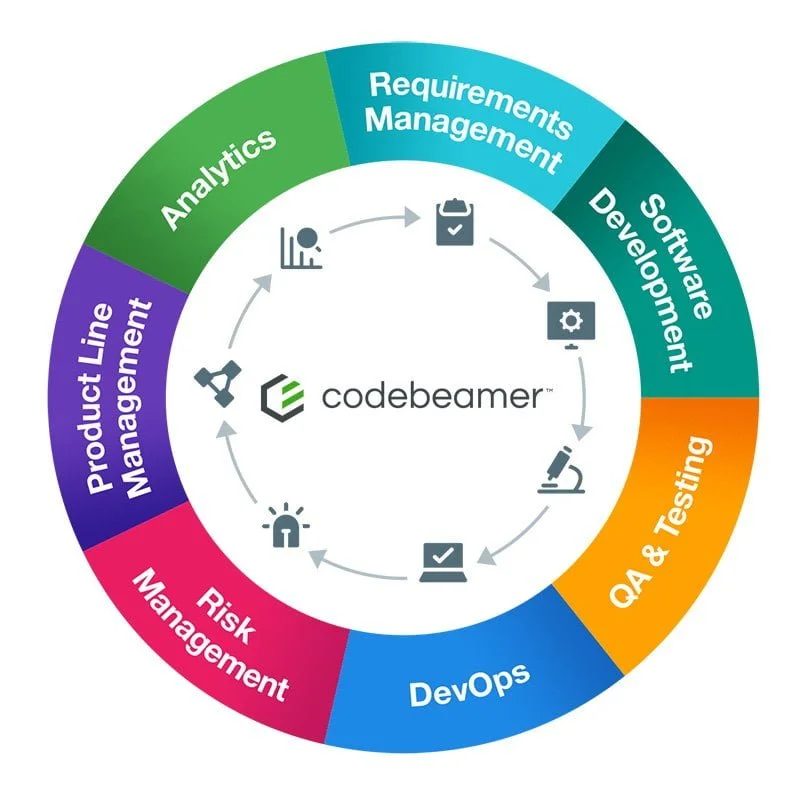
The workflow shown below illustrates how requirements, tests, and compliance stay connected throughout the aerospace development lifecycle.

AI-Assisted Requirements Authoring
Codebeamer AI helps teams generate, refine, and clarify requirements using consistent structure and terminology. Whether starting from scratch or improving existing specifications, teams can create high-quality requirements faster while reducing ambiguity and misinterpretation.
AI-Driven Test Creation and Traceability
Maintaining trace links manually is time-consuming and error-prone. Codebeamer AI automatically suggests test cases and keeps traceability accurate across requirements, tests, and other artifacts. This ensures end-to-end visibility and supports compliance without extra effort.
Intelligent Risk and Compliance Insights
In regulated industries, late discovery of compliance gaps can be costly. Codebeamer AI continuously analyzes requirements and related artifacts to detect inconsistencies, missing links, and potential regulatory risks early—helping teams stay audit-ready and avoid last-minute fixes.
| Feature | AI Capabilities | Key Benefits |
| Requirements Management | Codebeamer AI (Requirements Assistant) detects ambiguity, suggests clearer wording, and ensures alignment with industry standards. |
Reduces rework, improves specification quality, and ensures near-100% requirement coverage. |
| Test Management | Codebeamer AI (Test Case Assistant) generates and optimises test cases from requirements and maintains accurate trace links. |
Accelerates verification cycles, eliminates manual test creation errors, and improves product quality confidence. |
| Risk Management | Intelligent risk insights that detect gaps, inconsistencies, and regulatory exposures early in the lifecycle. |
Reduces defect leakage, ensures audit readiness, and minimises unplanned rework through automated impact analysis. |
| Workflow and Process Automation | Vivia (AI assistant) automates routine administrative ‘busywork’ and handles tedious procedural compliance tasks. |
Reduces administrative overhead by up to 80% and accelerates time-to-market by synchronising cross-functional teams. |
| Variant Management (PLE) | – | Optimises reuse across product lines and delivers new capabilities faster without losing traceability. |
Codebeamer AI doesn’t replace engineers, it supports them. By removing friction from everyday ALM activities, it enables faster development, better decision-making, and higher confidence at every stage of the lifecycle. For teams building complex, safety-critical, or regulated products, Codebeamer transforms ALM into a smarter, more efficient foundation for modern engineering.

