How do we transition global heavy industries to a zero-carbon future when renewable energy sources like wind and solar are inherently intermittent? Green hydrogen has emerged as a primary answer, serving as both a clean fuel and a massive energy storage medium. Yet, designing a scalable, efficient hydrogen ecosystem is an incredibly complex engineering puzzle. Balancing fluctuating power inputs, high-pressure storage constraints, and strict gas purity requirements requires more than traditional trial-and-error prototyping.
To overcome these hurdles, engineers are increasingly turning to virtual prototyping. By leveraging CATIA Dymola and specialized Modelica libraries, engineering teams can now simulate, optimize, and validate complex hydrogen systems long before physical deployment. This approach bridges the gap between conceptual design and real-world performance, significantly reducing development risks.
In this post, we explore how the latest updates in CATIA Dymola 2026 are revolutionizing hydrogen system design, from initial electrolysis to high-purity downstream treatment.
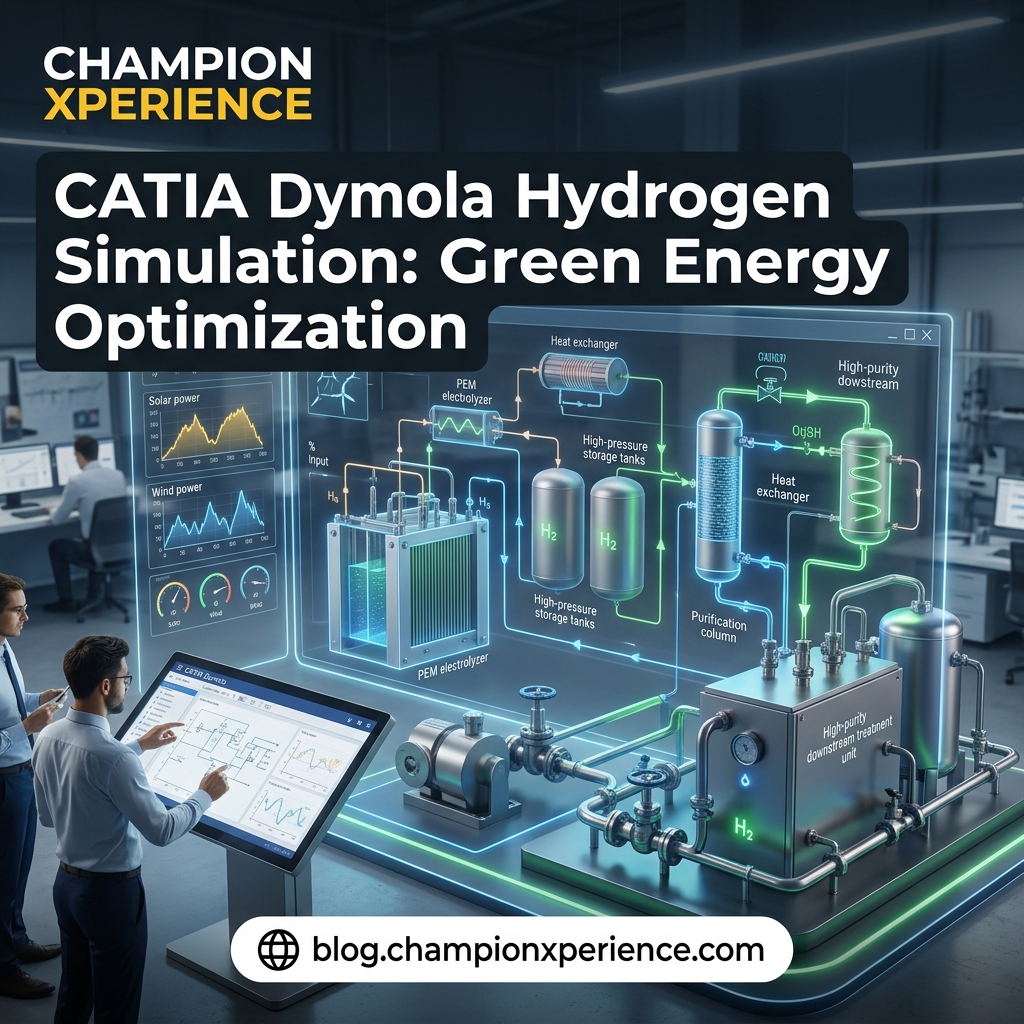
Green hydrogen production relies on electrolysis powered by renewable electricity. However, solar panels and wind turbines do not provide a constant, predictable stream of power. This variability introduces severe thermal and mechanical stress on downstream equipment, particularly PEM electrolyzers.
Engineers must design systems that can dynamically respond to these fluctuating inputs without sacrificing overall efficiency or safety. Sizing the system incorrectly leads to massive energy waste or premature equipment failure. System-level simulation allows teams to test different operational strategies and find the sweet spot between energy capture and storage capacity.
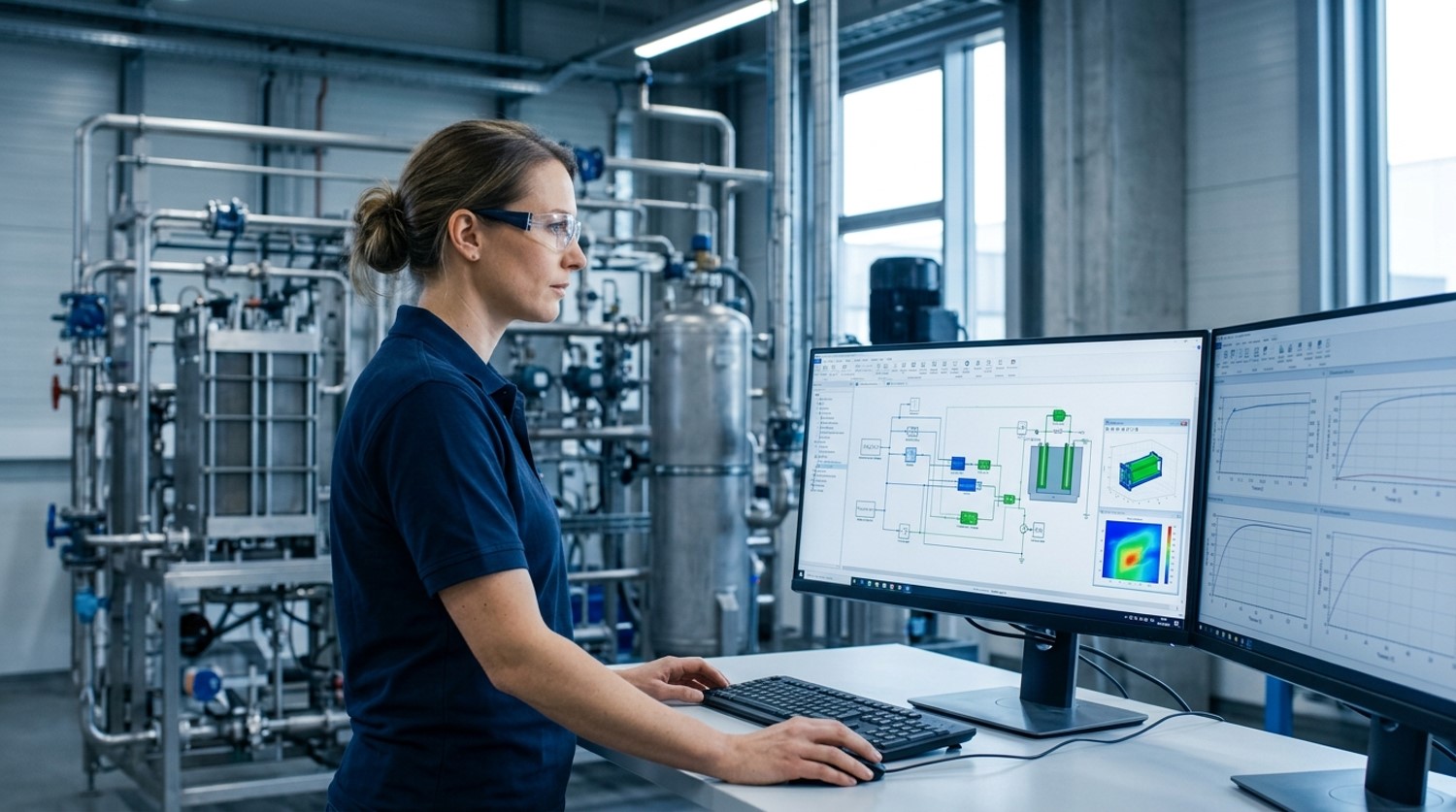
To simplify this complex modeling process, CATIA Systems provides a dedicated Hydrogen Library within Dymola. This library is built on the open-standard Modelica language, enabling fast, equation-based simulation of multi-domain physical systems 1.1.1. Instead of requiring hard-to-find, proprietary chemical equations, the library is designed for easy parameterization using standard manufacturer specifications.
The library provides ready-to-use models for critical system components, including:
By utilizing these pre-built components, engineers can quickly assemble complete hydrogen ecosystems. This makes it easy to run optimization studies to determine the ideal electrolyzer capacity for a specific wind farm or solar array, minimizing excess energy sent back to the grid.
Historically, high-fidelity system simulation was restricted to specialized analysis teams with deep expertise in Modelica coding. Dassault Systèmes is changing this dynamic by moving simulation capabilities to the cloud via the 3DEXPERIENCE platform. Through the web-based Systems Simulation Designer and Systems Simulation Analyst roles, simulation is now accessible to a much broader audience.
Non-experts can interact with predefined simulation cockpits directly within their web browsers. They can easily swap components, adjust parameters, compare different operational scenarios, and automatically generate reports. This democratization allows project managers, sales engineers, and plant operators to make data-driven decisions without needing to master complex desktop simulation tools.
Generating hydrogen is only half the battle; purifying it for industrial use is equally critical. For applications like fuel cell electric vehicles, even trace impurities can permanently damage the fuel cell stack. The Process Modeling and Engineering (PME) Library in Dymola addresses these downstream purification challenges.
By pairing the PME Library with Multiflash fluid property data, engineers can model advanced thermal separation and chemical purification processes. Two primary methods are heavily simulated:
This process involves cooling gas streams to extreme temperatures below -240°C. At these cryogenic levels, impurities like nitrogen, oxygen, and water vapor liquefy and separate, leaving behind hydrogen with purity levels approaching 100%.
For moisture removal, absorption systems utilize triethylene glycol to extract water vapor from the hydrogen stream. The glycol is then regenerated in a secondary thermal process, ensuring a continuous, highly efficient drying cycle.
To understand how these specialized tools fit into your workflow, let us look at how the Hydrogen Library and the PME Library compare:
| Feature / Capability | Hydrogen Library | Process Modeling & Engineering (PME) Library |
| Primary Focus | System-level energy balance, fuel cells, and electrolyzer sizing. | Chemical purification, thermal separation, and fluid thermodynamics. |
| Key Components | PEM electrolyzers, storage tanks, fuel cell stacks, reformers. | Distillation columns, absorption columns, heat exchangers. |
| Fluid Property Integration | Standard gas/liquid media models. | AdvancedMultiflashthermodynamic property data. |
| Typical Use Case | Determining the optimal battery-to-electrolyzer ratio for a green hydrogen plant. | Designing a cryogenic distillation column to achieve 99.99% hydrogen purity. |
The ultimate strength of CATIA Dymola lies in its multi-physics capabilities. It seamlessly bridges thermodynamics, chemical engineering, electrical systems, and control logic within a single, unified environment. Engineers can simulate an entire year of plant operations in just a few minutes, identifying long-term operational risks and seasonal efficiency drops before purchasing any physical equipment.
This rapid virtual testing accelerates decision-making, protects capital investments, and ensures that the final physical plant is optimized for maximum return on investment. As the global energy transition accelerates, having these predictive insights is no longer a luxury—it is a competitive necessity.
Are you ready to optimize your green energy workflows? How is your team currently handling the challenges of variable renewable inputs in your system designs?