Have you ever opened your PLM platform only to find yourself buried under a mountain of disconnected data, wishing you had a digital assistant to instantly map out the bottlenecks? If you have ever felt the frustration of waiting weeks for cross-departmental data validation, you are not alone. The gap between engineering design, laboratory research, and the physical shop floor has long been a costly hurdle in the process industries.
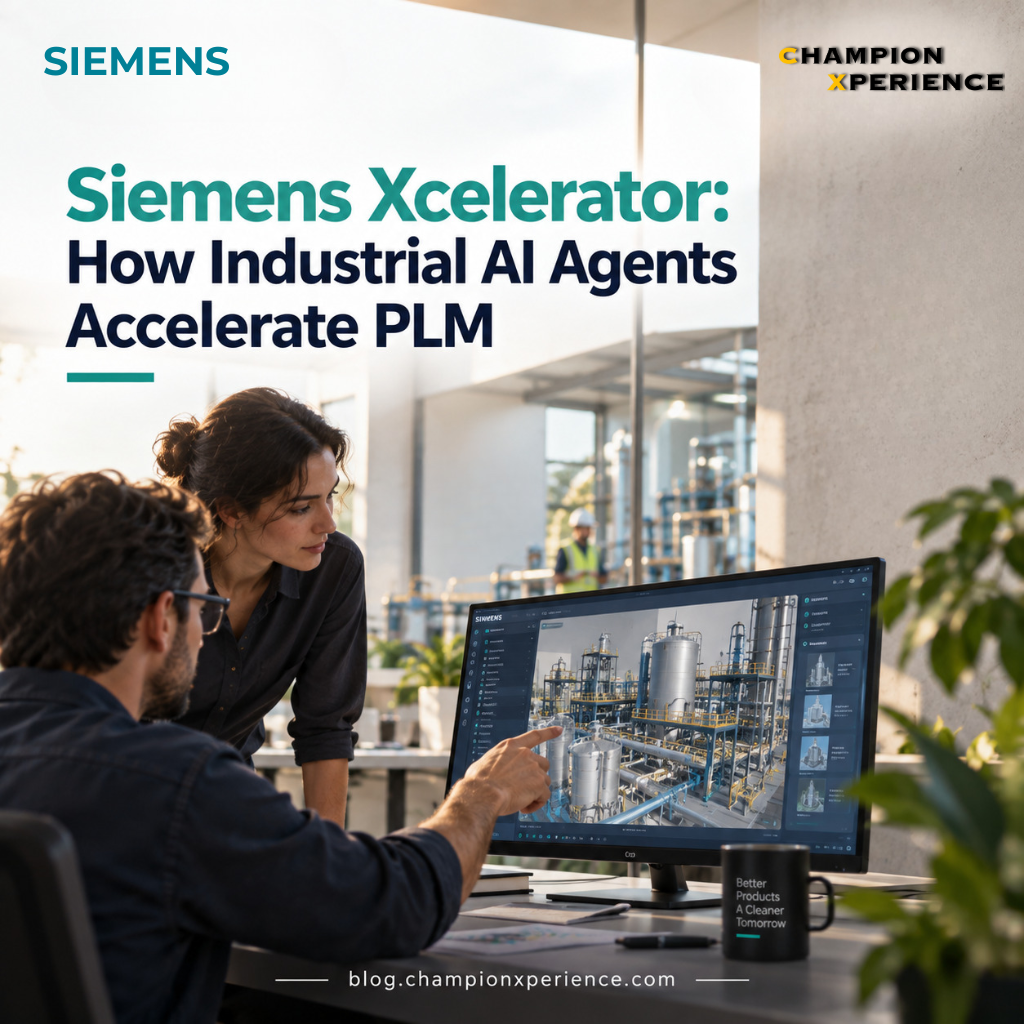
But the landscape is shifting. We are moving past the era of passive AI chatbots that merely answer questions. Today, the integration of generative AI with the comprehensive Digital Twin is turning static data into a dynamic, self-optimizing ecosystem. By combining physics-based simulation with autonomous agentic workflows, the Siemens Xcelerator business platform is helping organizations turn complex, disconnected lifecycle data into practical, sustainable value.
If you are ready to see how this transition is reshaping the manufacturing floor, let’s begin.
Industrial AI is not a one-size-fits-all solution. A researcher in a laboratory, a product developer running stress tests, and a plant operator managing a full-scale commercial manufacturing facility all require vastly different datasets. To make this data actionable, companies must maintain a seamless digital thread that preserves critical context across the entire product lifecycle.
A recent Siemens Thought Leadership podcast with John Nixon and Bill Hahn highlights the importance of context in industrial data.
When a product moves from the lab to pilot production, its key data must stay connected. Without a unified digital thread, important engineering details can be lost. This can lead to manufacturing errors and longer time-to-market.
For the past few years, the industry has focused heavily on AI copilots—tools that help engineers write code or query manuals using natural language. However, the industry is entering the era of “Agentic AI” . Instead of waiting for a user command, these specialized AI agents can perceive, reason, act, and continuously learn to execute complex, multi-step workflows autonomously .
A good example is Siemens Intelligence Center X, which helps move AI from pilot projects into real production workflows. It connects enterprise data and lifecycle context so people and AI agents can work together.
The Eigen Engineering Agent goes a step further. Within TIA Portal, it can generate PLC code, create HMI visualizations, and identify inconsistencies in automation projects.
These operations agents democratize knowledge across the organization. Instead of submitting a support ticket and waiting days for a response, a shop floor technician can simply ask a plant agent for real-time status updates, instantly identifying process deviations or maintenance needs.
To truly eliminate guesswork on the production line, organizations must combine the physical accuracy of simulation with the speed of AI. The comprehensive Digital Twin allows engineers to simulate everything from initial concepts to direct interactions with finalized physical assets. By feeding historical operational data into industrial AI models, systems can predict potential bottlenecks before they manifest physically.
The Digital Twin Composer on the Siemens Xcelerator Marketplace lets companies simulate plant upgrades in a virtual environment powered by NVIDIA Omniverse. Engineers can test changes digitally before physical commissioning.
AI then helps optimize the simulation by adjusting parameters for safer and more efficient operations.
To understand the practical impact of these technologies, let’s look at how traditional engineering and operational workflows compare to an agentic, AI-driven approach.
| Workflow Phase | Traditional Approach | Agentic AI Approach |
| Data Integration | Manual data transfer between siloed PLM, ERP, and CAD tools. High risk of context loss. | Unified digital thread with shared enterprise context via tools likeIntelligence Center X. |
| PLC & HMI Engineering | Sequential, manual programming and manual verification of electrical schematics. | Autonomous generation and self-correction of code using theEigen Engineering Agent. |
| Issue Resolution | Siloed communication, manual log analysis, and long waiting times for expert support. | Instant query resolution and automated diagnostics via specialized plant and operations agents. |
| Process Optimization | Reactive adjustments based on historical reports and physical trial-and-error. | Predictive bottleneck detection and real-time parameter validation using physics-based Digital Twins. |
Industrial AI is changing how process companies work. Manufacturers can capture real-time field data and use it to improve product designs.
This creates a continuous feedback loop. Each new product iteration becomes smarter, safer, and better aligned with customer needs.
As we look ahead, the boundary between the digital design space and physical operations will continue to dissolve. The question is no longer whether you should adopt AI, but how quickly you can integrate autonomous agents into your existing engineering workflows to stay competitive.
How is your organization preparing for the transition to Agentic AI? Are you ready to deploy autonomous agents alongside your engineering team, or do you prefer to keep them strictly in supportive, copilot roles? Let us know your thoughts in the comments below!