Have you ever had a generative AI tool give you a smooth, confident answer to a engineering question, only to realize seconds later that its proposed bracket geometry would buckle under half its nominal load? If so, you are not alone. Generic text-based artificial intelligence is great at generating fluent prose and convincing code, but it lacks an understanding of shear stress, fluid turbulence, or electromagnetic fields.
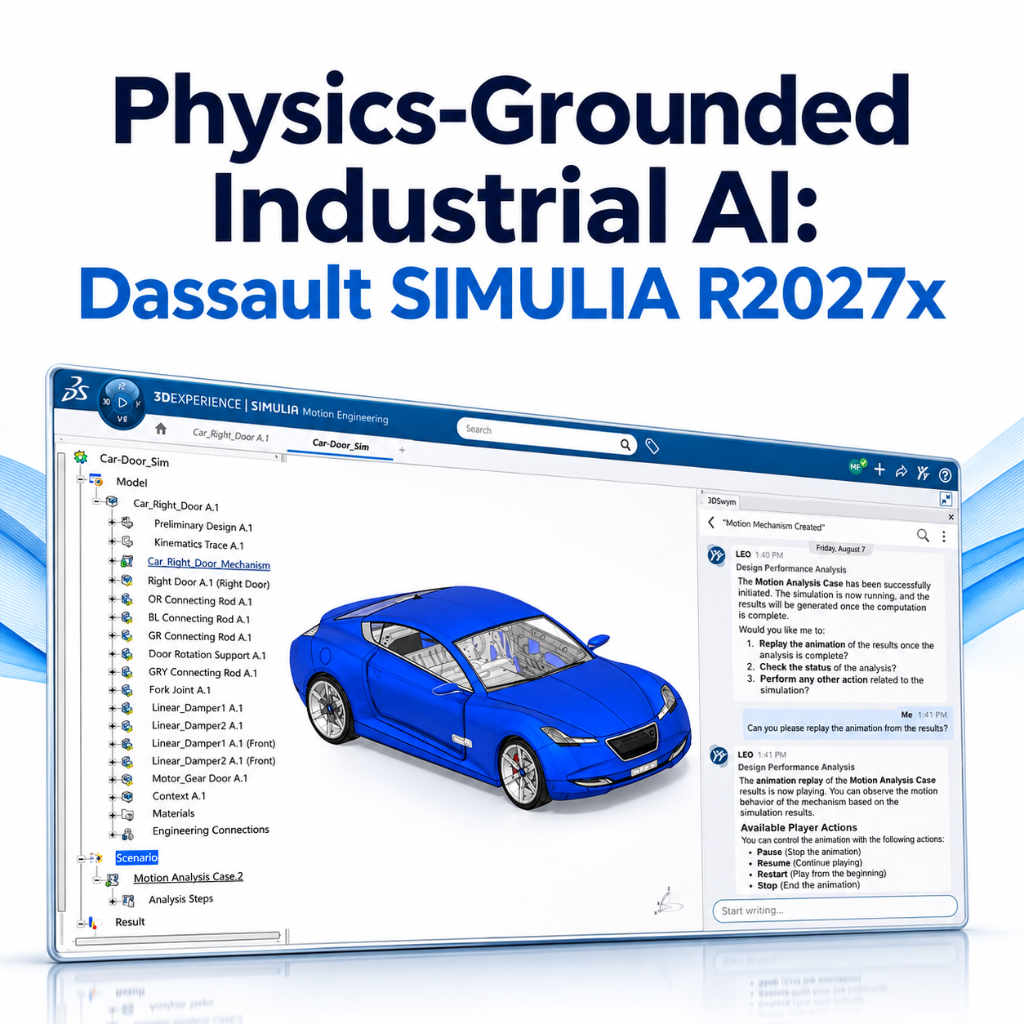
That fundamental gap—where surface-level plausibility meets raw physical reality—is exactly where engineering product risk lives. Dassault Systèmes is directly tackling this challenge with its announcement of SIMULIA R2027x on the 3DEXPERIENCE platform. By introducing physics-grounded Industrial AI, the platform anchors machine learning models directly into proven, validated simulation solvers rather than relying on pure language models.
If you are ready to see how AI is shifting from a generic chat assistant into a physics-aware co-pilot for mechanical designers and simulation specialists, let’s dive into the details.
When engineering teams evaluate AI tools, speed is usually the primary headline. However, as SIMULIA CEO Michelle Ash and R&D Vice President Christian Whiting point out, speed without verified physical accuracy creates liabilities down the line. Having an AI assistant in your workflow is quickly becoming table stakes; the true competitive edge will belong to teams using AI that inherently respects the laws of physics.
Physics-grounded Industrial AI relies on Industry World Models built directly on top of SIMULIA‘s established solver engines. Instead of predicting the next token in a text stream, these models are trained on validated multiphysics simulation datasets—spanning finite element analysis (FEA), computational fluid dynamics (CFD), and multibody dynamics.
Dassault Systèmes highlights three core pillars for this industrial AI framework:
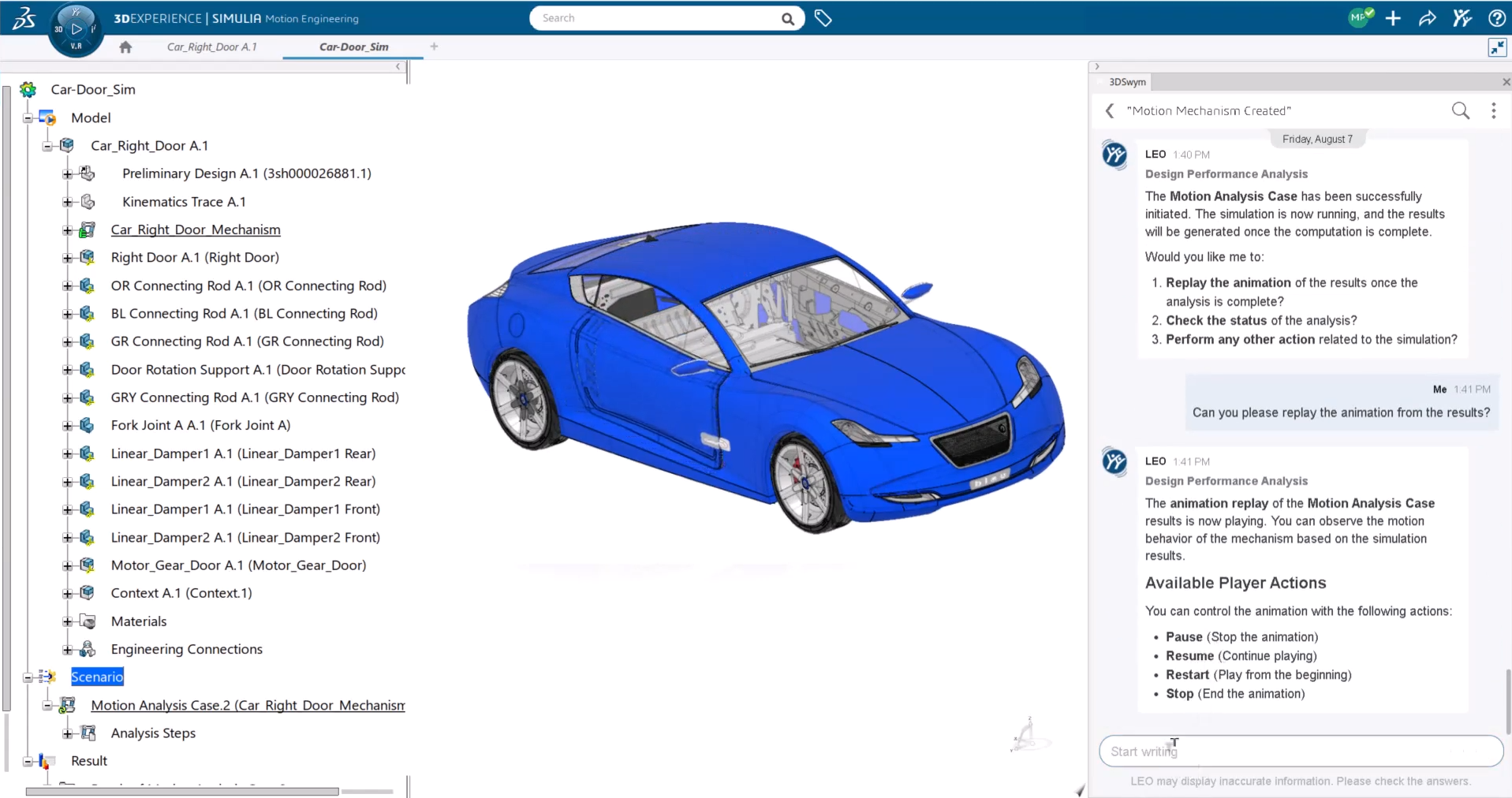
A key highlights of the SIMULIA R2027x announcement is LEO, an agentic AI Virtual Companion operating natively inside the 3DEXPERIENCE environment [1]. Unlike basic chatbots that merely answer static support queries, LEO is an active agent capable of performing complex operational tasks.
Through natural language prompts, engineers can instruct LEO to set up simulation studies, define boundary conditions, trigger solver runs, and filter post-processing stress contours. LEO executes these commands using the underlying SIMULIA solver engine, guaranteeing that every analysis result is scientifically validated.
For simulation analysts, routine pre-processing—such as geometry cleanup, mesh generation, and contact definition—often consumes the majority of a project’s timeline. LEO automates these repetitive chores, giving specialists more time to concentrate on complex trade-off studies and structural optimization [1].
For mechanical design engineers working in CATIA, LEO democratizes simulation. Designers can ask plain-language questions like “What is the safety factor of this bracket under a 5 kN vertical load?” and receive guided, step-by-step simulation setups without leaving their modeling workspace.
Historically, full high-fidelity 3D multiphysics simulations required hours—or even days—of high-performance computing (HPC) time. This time lag forced design teams to run simulation checks late in the process, turning analysis into a validation step rather than an early design driver.
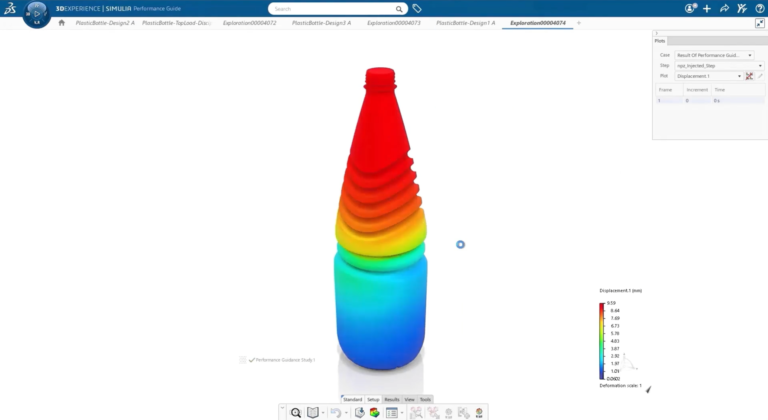
The Virtual Twin of Physics Behavior in SIMULIA R2027x alters this dynamic completely. By training deep neural networks on validated SIMULIA solver data, the platform provides near real-time 3D predictions during early geometric conceptualization [1].
Designers pushing surface features in CATIA can observe instantaneous feedback on thermal dissipation, stress concentrations, or airflow patterns. Once the design space is narrowed down to the top candidates, engineers run final high-fidelity SIMULIA solver passes to confirm structural integrity before committing to physical prototypes.
At the center of these AI capabilities is MODSIM (Unified Modeling and Simulation). Traditional product development separates CAD design and CAE analysis into disconnected silos, requiring file conversions (such as STEP or IGES exports), manual re-meshing, and broken revision histories.
MODSIM unifies CAD geometry and CAE simulation data under a single underlying data structure on the 3DEXPERIENCE platform. Because CATIA and SIMULIA share the exact same object model, geometric revisions instantly update the associated mesh, load cases, and results. This seamless connection provides the clean dataset required for LEO and physics AI agents to operate across the full lifecycle.
To highlight why ground-truth solvers are critical for engineering software, let’s examine how generic text models compare to physics-grounded AI tools like SIMULIA R2027x.
| Capability / Feature | Generic Text LLMs | Physics-Grounded Industrial AI (SIMULIA) |
| Core Training Source | Internet text, articles, public web code | Validated 3D FEA/CFD solver runs & material physical laws |
| Physical Validation | None (susceptible to physical hallucinations) | Strictly verified against conservation of momentum/energy |
| CAD/CAE Execution | Text generation & simple script drafting | Agentic action (LEO automates mesh, setup, and post-processing) |
| CAD/CAE Integration | Third-party chat plugins | NativeMODSIMintegration insideCATIAandSIMULIA |
| Enterprise Security | Varies (risk of public data leakage) | Sovereign enterprise environment on3DEXPERIENCE Cloud |
Dassault Systèmes will present live demonstrations of these innovations during two upcoming release keynotes [1]:
How is your team currently exploring AI inside your design and simulation workflows? Are you excited to hand off routine mesh setup to an agentic virtual companion like LEO? Let us know your thoughts in the comments below, or subscribe to the Champion Xperience blog for our upcoming technical deep-dive following the keynotes!
Source Attribution: Original announcements and executive interviews sourced from the 3DS SIMULIA Blog.