The EV Design Dilemma: Balancing Battery Weight with Green Materials
Have you ever looked at the specifications of a modern electric vehicle (EV) and wondered how engineers manage to keep them structurally safe while carrying a massive battery pack? It is a massive challenge. On one hand, you have the heavy traction battery requiring robust physical protection and thermal management. On the other hand, you have strict global mandates to reduce vehicle weight and slash lifecycle carbon emissions. If you are an automotive engineer, you know this struggle all too well.
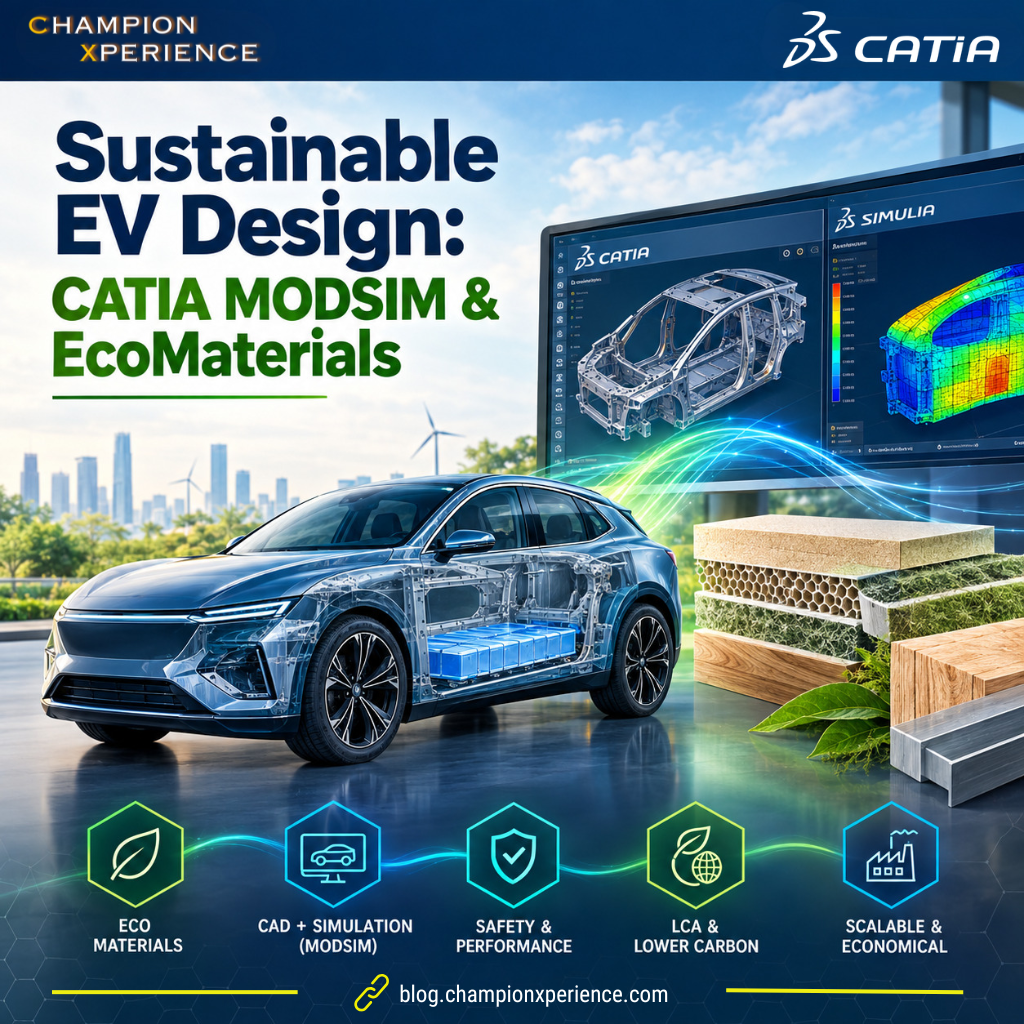
Historically, solving these issues meant endless back-and-forth handovers between CAD designers and simulation specialists. By the time a crash simulation revealed a structural flaw, weeks had passed, and the design had already moved forward. Today, that slow, siloed approach is no longer viable. Automotive pioneer Denis Schmitz is demonstrating how to break these traditional barriers by combining advanced eco-materials with a unified modeling and simulation workflow, as highlighted in the 3DS Blog. By utilizing CATIA, SIMULIA, and the 3DEXPERIENCE platform, engineers can now design, simulate, and track environmental impacts simultaneously.
If you are tired of exporting STEP files, rebuilding meshes, and losing critical design history during department handovers, you need to know about MODSIM (Modeling and Simulation). This paradigm shifts simulation from a late-stage validation tool to an active driver of the initial design phase. Instead of treating CAD and CAE as separate disciplines, MODSIM unifies them on a single data model within the 3DEXPERIENCE platform.
When you modify a parametric feature in CATIA, the corresponding finite element model in SIMULIA updates automatically. This continuous digital thread eliminates translation errors and slashes development cycles. For complex EV architectures—where battery enclosures must double as load-bearing structural members—this real-time feedback loop is a game-changer. It allows design teams to run dozens of structural iterations in the time it used to take to complete just one.
To hit aggressive decarbonization targets, we have to look beyond traditional steel and aluminum. Engineers are increasingly exploring advanced sandwich composites and even wood-based materials for structural and semi-structural components. For instance, Schmitz partnered with StrongByForm to develop a lightweight sandwich roof structure designed to maximize passenger headroom while maintaining high crash performance and thermal isolation.
How do these alternative materials compare to traditional automotive metals? The table below outlines the trade-offs engineers must evaluate early in the design cycle:
| Material Class | Weight Saving Potential | Carbon Footprint (Raw) | Primary Structural Benefit | Key Manufacturing Challenge |
| High-Strength Steel | Baseline | High | Excellent energy absorption | High stamping press costs |
| Aluminum Alloys | Moderate to High | Very High (unless recycled) | Excellent strength-to-weight | Complex welding/joining |
| Sandwich Composites | Very High | Moderate | High bending stiffness, acoustics | Cycle times and assembly integration |
| Wood-Based Composites | High | Very Low (Carbon-negative potential) | Natural damping, low raw footprint | Moisture resistance, scaling tooling |
Evaluating these options requires more than just mechanical testing. You must also understand how these materials behave under extreme stress, which is where advanced simulation comes into play.
In an electric vehicle, the battery pack is the most vulnerable and expensive component. Protecting it during a side pole impact or a small overlap crash requires highly controlled load paths. You cannot afford to guess where the structural deformation will occur.
Using SIMULIA on the 3DEXPERIENCE platform, engineers can perform rigorous quasi-static analysis and dynamic crash simulations directly on the active CAD model. This allows you to visualize how a sandwich composite roof or a wood-based floor panel will deform under load. By identifying potential failure points early, you can implement parametric design changes and use topology optimization to reinforce high-stress areas while removing excess material from low-load zones. The result is a highly optimized, lightweight structure that guarantees occupant safety and battery integrity.
True sustainability is not just about tailpipe emissions; it is about the entire lifecycle of the vehicle. This is where the EcoDesign application on the 3DEXPERIENCE platform becomes indispensable. Integrated directly into the engineering workspace, this tool allows you to perform a comprehensive Life Cycle Assessment (LCA) as you design.
The software tracks carbon emissions across the entire value chain, including:
By embedding LCA data directly into the virtual twin, engineering teams can make data-driven decisions. For example, you can instantly compare the carbon footprint of sourcing a bio-based composite versus a recycled aluminum alloy, ensuring your design aligns with corporate sustainability KPIs before any physical prototype is built.
An eco-friendly design is only successful if it can be produced economically at scale. Choosing a cutting-edge composite material that requires massive presses and multi-stage tooling might make sense for a low-volume supercar, but it is highly unbalanced for a mass-market passenger vehicle.
Through the unified 3DEXPERIENCE environment, engineers can evaluate production technologies and tooling costs in parallel with material performance. This holistic view ensures that your manufacturing processes align perfectly with your targeted production volumes. It prevents costly late-stage redesigns and ensures that your sustainable EV is both environmentally friendly and commercially viable.
Are you ready to break down the walls between your design and simulation teams to build the next generation of sustainable vehicles?
This guide is based on insights from the official DS Blog