Dassault Systèmes and Vertiv are collaborating to configure, simulate, and validate AI factory infrastructure before construction, combining the 3DEXPERIENCE platform, virtual twins, and Vertiv’s power and cooling solutions.
Dassault Systèmes and Vertiv have announced a collaboration aimed at accelerating the design and deployment of AI factories based on NVIDIA DSX reference architectures. Announced on October 22, 2026, the partnership combines Dassault Systèmes’ 3DEXPERIENCE platform and virtual twin capabilities with Vertiv’s expertise in critical digital infrastructure.

The objective is to help engineering teams validate complex AI factory infrastructure virtually before construction begins, reducing on-site complexity and accelerating the time required to bring AI computing capacity online.
AI factories require multiple interconnected systems to operate together, including computing hardware, power distribution, cooling, networking, and control systems. Changes in one area can affect the performance and requirements of other systems, making integrated design and validation essential.
Through this collaboration, Dassault Systèmes and Vertiv aim to address these challenges using model-based systems engineering, simulation, and virtual twins.
The 3DEXPERIENCE platform will enable Vertiv’s pre-engineered power and cooling solutions to be represented as configurable system models. Engineers can use these models to evaluate different infrastructure configurations, assess the effects of design changes across engineering disciplines, and perform system-level and multiphysics validation before physical deployment.
This approach is intended to provide a common engineering environment in which teams can maintain design intent from initial configuration through construction, commissioning, and future infrastructure upgrades.
The collaboration builds on Vertiv SmartRun’s configurable virtual twin and expands the model-based approach to additional AI factory infrastructure solutions, including Vertiv OneCore.
Vertiv OneCore is a hybrid-built data center solution integrating critical power, thermal management, and supporting infrastructure. By representing these systems as an integrated virtual model, engineering teams can improve visibility into system interactions and understand how proposed design changes may affect the overall infrastructure.
The companies also plan to apply this approach to AI factories based on the NVIDIA Vera Rubin DSX AI Factory reference design and the NVIDIA Omniverse DSX Blueprint.
The workflow is designed to turn pre-engineered infrastructure assets into configurable models that can be adapted to customer-specific requirements. Rather than relying on a fixed design, engineers can evaluate alternatives, propagate changes across disciplines, validate system behavior, and generate engineering deliverables from a shared environment.
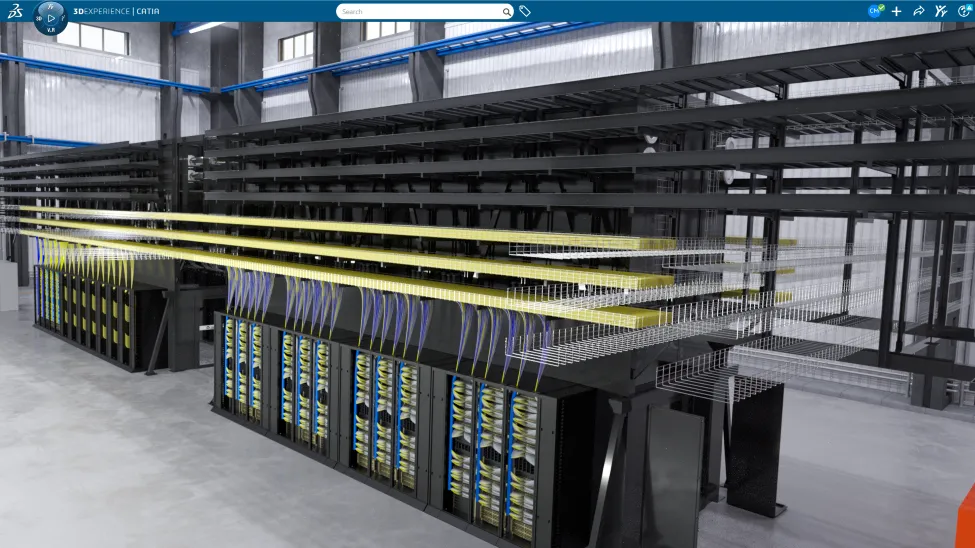
According to the companies, the collaboration targets several potential improvements in AI factory design and deployment:
These figures are modeled targets and outcomes, not verified results from a completed customer deployment. The projected increase in token output reflects earlier facility readiness rather than improved operating efficiency.
The companies are showcasing elements of their approach at NVIDIA GTC Berlin, held October 20–22, 2026.
The demonstration brings together the NVIDIA Vera Rubin DSX AI Factory reference design, NVIDIA Omniverse DSX Blueprint, Dassault Systèmes’ 3DEXPERIENCE platform and model-based systems engineering capabilities, and Vertiv’s SimReady power and cooling assets.
The demonstration illustrates how facility requirements can inform infrastructure configuration and how engineering teams can evaluate power and cooling constraints virtually before deploying factory-built infrastructure.
The partnership highlights the growing role of virtual twins and model-based systems engineering in designing complex, interconnected infrastructure.
For engineering teams, the approach goes beyond visualizing a facility in 3D. It aims to provide a structured way to evaluate system interactions, assess design changes, and validate infrastructure configurations before committing to physical construction.
As AI infrastructure becomes more complex, integrating simulation and systems engineering into early design decisions could help organizations identify potential issues sooner and improve coordination between disciplines.
The partnership also highlights how digital engineering platforms are moving beyond traditional product development into large-scale infrastructure. Engineers can use these platforms to design and validate power, cooling, computing, and other interconnected systems within a unified environment.
Source: Dassault Systèmes, press release dated October 22, 2026.