Let’s be completely honest about a reality the manufacturing industry has quietly tolerated for decades: we have built entire systems around managing errors rather than eliminating them. Misread work instructions, approximate torque specs, and slightly misaligned welds are often accepted as part of doing business. The industry calls this the “margin of error.” As a result, manufacturers build these expected mistakes into production schedules, contingency budgets, and engineering concession workflows. Over time, errors have become normalized.
But normalized does not mean acceptable. In high-complexity, low-tolerance sectors like aerospace, defense, and heavy machinery, a single misassembled component can ground an entire fleet or halt a production line for weeks. The financial impact is staggering. According to the American Society for Quality, poor quality costs the average manufacturer between 15% and 20% of their annual sales revenue. For most facilities, this quality gap represents a massive leak that could otherwise fund entire digital transformation initiatives.
The worst part? Most of this cost isn’t sitting in the scrap bin. It disappears into invisible drains: endless rework, late-stage issues discovered during final inspection, and engineering changes that pull your best designers away from developing new products and into solving shop-floor problems.
When a defect escapes to a customer, the “rule of ten” kicks in—fixing a problem in the field costs ten times more than catching it at final inspection, and a hundred times more than preventing it during assembly. It is time to stop managing the margin of error and start erasing it.
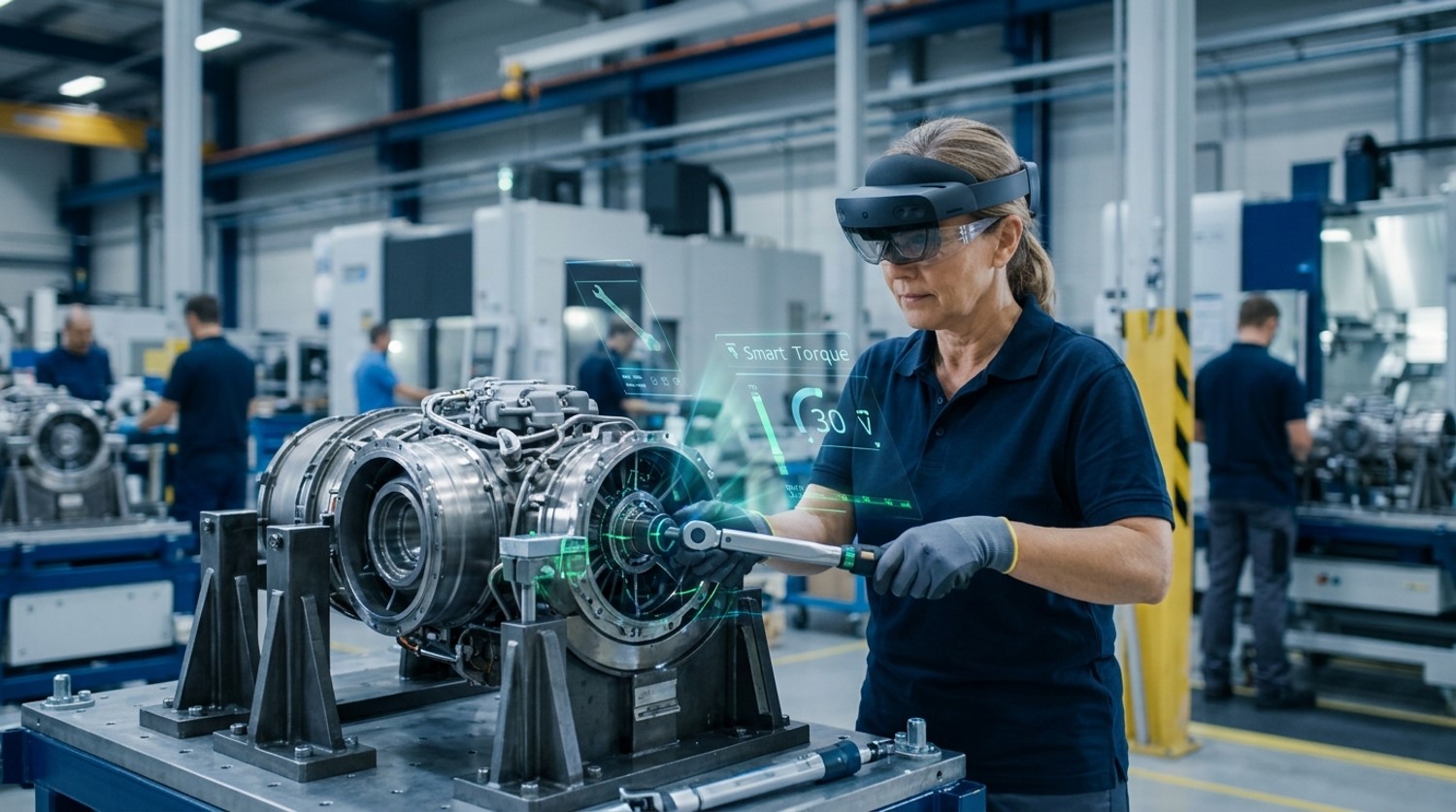
When assembly errors occur, the immediate reaction is often to blame operator fatigue or a lack of training. But the root cause is rarely the workforce. The real culprit is how information is delivered to the physical workspace. Asking a technician to look at a 2D paper drawing or a flat PDF on a tablet, mentally translate that digital design into a physical 3D assembly, and execute it flawlessly while holding heavy tools is a recipe for cognitive overload.
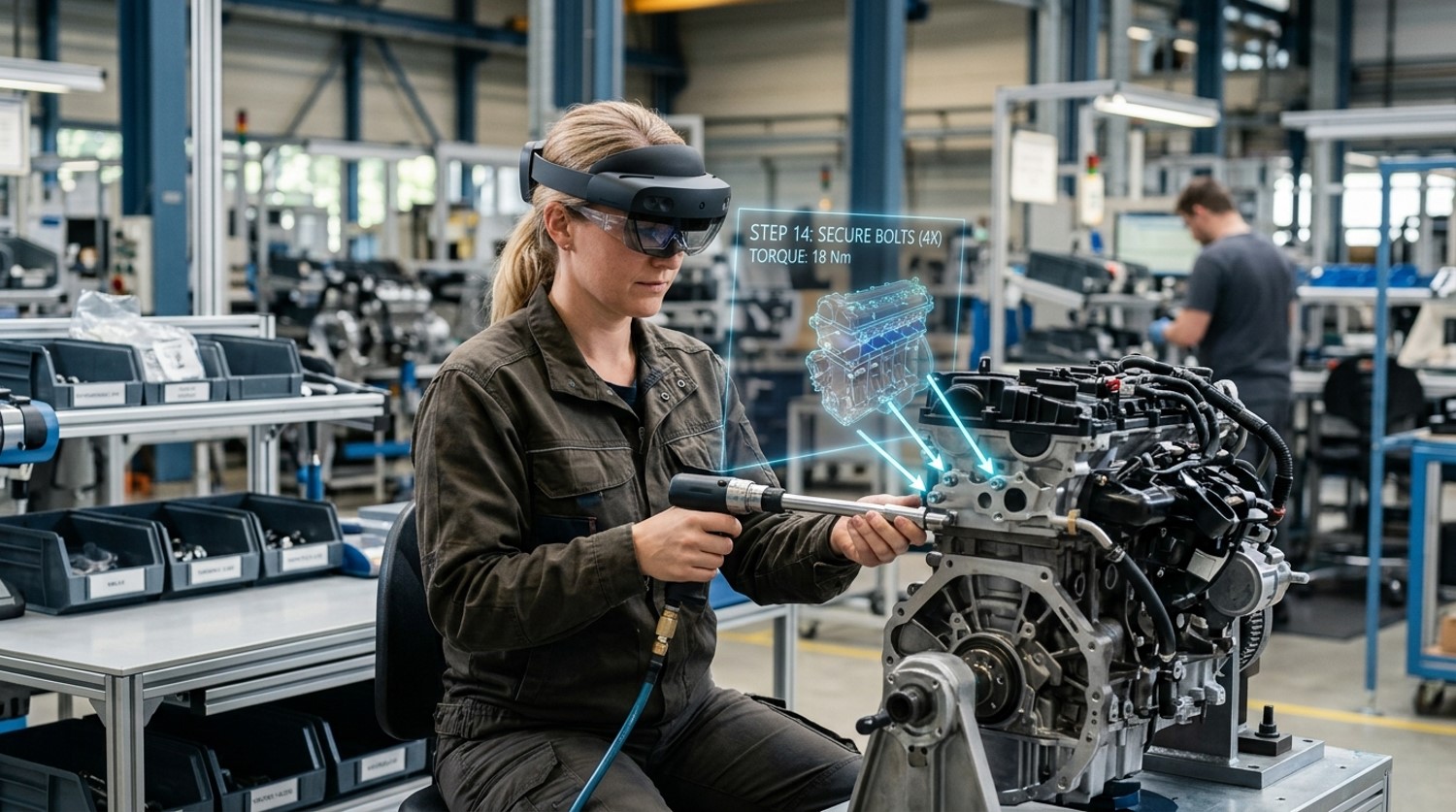
A technician installing complex brackets or routing wire harnesses is working in a physical, three-dimensional space. When their instructions are trapped on a flat screen or a piece of paper, they must constantly look away from their work, interpret the drawing, and map it to the physical part. If step 47 looks nearly identical to step 48—save for a bracket positioned three inches lower—the human brain under fatigue will naturally rely on memory and approximation. This is where missing, mislocated, or misoriented components slip through the cracks.
Traditional quality control relies heavily on post-assembly inspection. A quality checker works through a massive, point-by-point control plan long after the assembly work is complete. If they find a defect, the context of how and when it occurred is completely lost. The subsequent investigation takes hours, halts downstream stations, and requires pulling multiple engineers into a huddle to determine the path forward. Quality cannot be inspected into a product; it must be built into the process.
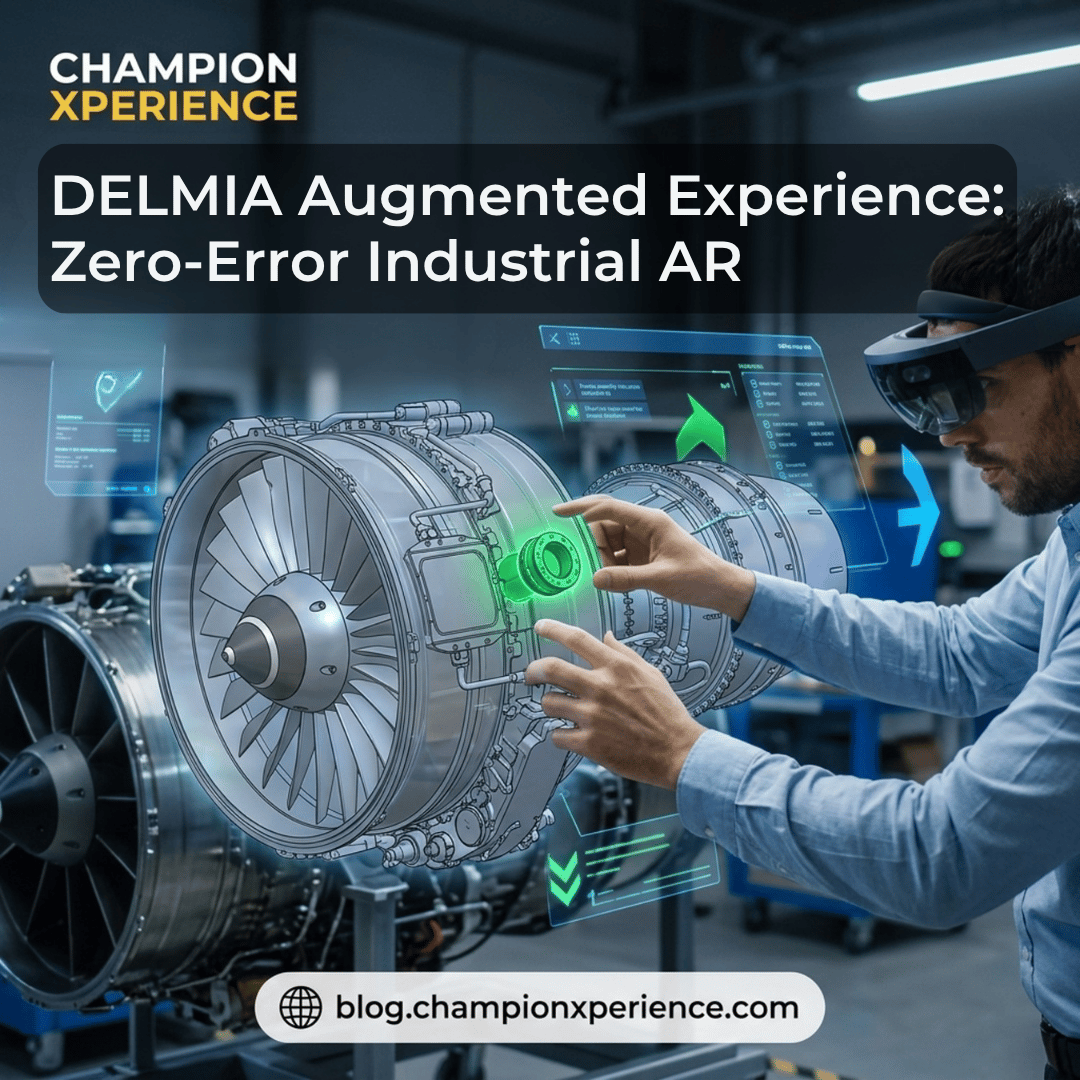
To eliminate the margin of error, we must close the gap between digital engineering intent and physical execution. This is exactly what DELMIA Augmented Experience achieves. By leveraging industrial Augmented Reality (AR) and Digital Twin technology, this solution projects precise, real-time 3D instructions directly onto the physical workpiece.
Instead of cross-referencing a manual, operators see exactly where every bracket, fastener, and weld needs to go, mapped directly onto the physical part geometry. The system enforces the correct assembly sequence, displays specific torque values, and verifies each step before allowing the operator to proceed. The digital model acts as a continuous, real-time benchmark for quality, making errors virtually impossible to commit.
| Manufacturing Phase | Traditional Paper/PDF Methods | DELMIA Augmented Experience (AR) |
| Assembly Guidance | Operators mentally translate 2D drawings to 3D physical parts; high risk of mislocated components. | Precise 3D CAD models are projected directly onto the physical workspace, showing exact placement. |
| Sequence Enforcement | Relies on operator memory and manual checklists; steps can easily be skipped. | Interactive, step-by-step digital workflows ensure tasks are completed in the exact engineered order. |
| Quality Inspection | Post-assembly checks using manual tools; defects are documented in separate text reports. | Real-time, AR-guided control plans map defects directly to 3D part geometry for instant tracking. |
| Traceability & Data | Manual data entry or paper logs; high lag time and risk of lost information. | Automated data collection and closed-loop integration with MES/MOM systems for full digital traceability. |
This is not a futuristic concept—it is actively transforming top-tier manufacturing facilities today. Major aerospace and defense companies are using DELMIA Augmented Experience to achieve unprecedented quality benchmarks from their very first production runs.
As one of the world’s largest tier-one suppliers of aerostructures, Spirit AeroSystems faces immense complexity when building large commercial and defense aircraft assemblies. One of their persistent challenges was the escape of missing, mislocated, or misoriented brackets—errors that could disrupt their customers’ assembly flows downstream.
To solve this, Spirit AeroSystems integrated DELMIA Augmented Experience directly into their production line. They launched their 3D CAD models from CATIA directly into the AR environment, allowing the software to automatically detect the wireframe of the physical parts. By overlaying the precise digital design onto the physical aircraft structure, mechanics and inspectors can easily verify bracket locations without searching through paper files. The result? Their fully closed-loop quality system integrates with the manufacturing execution system, drives errors down to zero, and ensures parts are built “Right First Time.”
The success of these industry leaders shows that an “acceptable margin of error” is not a structural necessity. It is the result of an outdated way of delivering information. By replacing 2D drawings with real-time, model-based AR guidance, manufacturers remove the cognitive burden on operators and significantly reduce errors.
For manufacturers in highly regulated industries, the business case for industrial AR is clear. It is not just about saving a few minutes each shift. It helps manufacturers protect margins, strengthen supply chains, and build every product right the first time.
Are you ready to replace paper manuals and put the power of the digital twin directly into your operators’ hands? How is your team addressing the hidden costs of rework on the shop floor?
This guide is based on insights from the official Dassault Systèmes Blog .