Have you ever looked closely at the medicine cabinet in your home? The sheer variety of tablet shapes, sizes, and coatings is not just a design choice—it is a highly engineered functional requirement. A minor tweak in a tablet’s geometry can completely alter how fast it dissolves, how easily a patient swallows it, and how effectively it delivers its active ingredients.
For decades, pharmaceutical companies have struggled with a massive bottleneck: the physical trial-and-error of tablet compaction. Designing a pill that does not crumble, chip, or stick during high-speed manufacturing has traditionally required weeks of expensive lab testing. But that paradigm is shifting. By bringing unified Modeling and Simulation (MODSIM) to the 3DEXPERIENCE platform, Dassault Systèmes is changing how tooling designers and formulation experts collaborate to build the next generation of life-saving therapies.
In a typical manufacturing setup, the tableting process looks straightforward. You blend the pharmaceutical powder, fill a die, apply a light pre-compression, and then hit it with the main high-pressure compression to form the final tablet. Finally, the tablet is ejected from the machine.
In reality, this high-speed mechanical process is a minefield for defects. The extreme pressures and subsequent release of forces often lead to severe manufacturing failures:
Traditionally, formulation experts had to select a standard tool shape, run physical compaction tests in a lab, and evaluate the physical properties like hardness and friability. If the tablet failed, they had to redesign the physical tooling and start over. This iterative cycle is incredibly slow, wastes valuable active pharmaceutical ingredients (APIs), and delays critical drugs from reaching patients.
This is where MODSIM comes in. Rather than treating computer-aided design (CAD) and computer-aided engineering (CAE) as two separate, siloed departments, MODSIM unifies them on a single data model. Historically, a designer would build a CAD model and “throw it over the wall” to a simulation specialist, who would have to translate the file, clean up the geometry, and set up the mesh from scratch. If a design change was needed, the entire tedious cycle repeated as detailed by industry experts at GoEngineer.
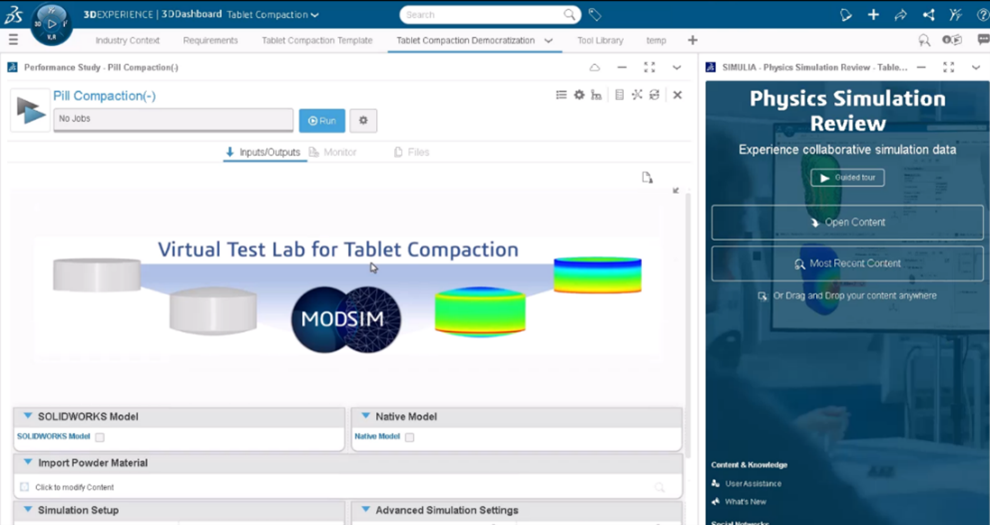
By integrating SOLIDWORKS directly with advanced SIMULIA Abaqus solvers on the 3DEXPERIENCE platform, MODSIM establishes a single source of truth. When a tooling designer modifies a tablet’s radius in SOLIDWORKS, the underlying simulation model updates automatically. This democratization of simulation allows formulation experts—who may not be advanced finite element analysis (FEA) specialists—to run complex physics-based validations early in the design phase.
To bypass physical trial-and-error, Dassault Systèmes has outlined a streamlined, four-step virtual prototyping workflow on the 3DEXPERIENCE platform.
Everything starts with the geometry. Designers can build a parametric tool assembly directly within SOLIDWORKS or the 3DEXPERIENCE platform. SOLIDWORKS users can leverage this in two ways:
Powder compaction is incredibly complex. It transition from initial particle rearrangement to elastic-plastic deformation, followed by nonlinear elastic recovery (dilation) once the compaction force is released. To capture this behavior, the workflow utilizes the built-in Drucker-Prager model with Cap Plasticity. Using the platform’s material calibration app, formulation experts can easily input physical test data to calibrate these advanced material models without needing a PhD in material science.
With the geometry and material properties locked in, the simulation mimics the physical punch and die process. The software calculates key performance indicators (KPIs) such as relative density distribution, stress concentration zones, and ejection forces. This allows engineers to spot potential capping or sticking zones before a single physical tool is cut.
By utilizing the multidisciplinary optimization engineer role, simulation specialists can package these complex FEA setups into standardized, reusable templates. A formulation scientist can simply import their SOLIDWORKS CAD library, select the pre-calibrated powder material, run the template, and immediately see if the design meets the required relative density and thickness specifications.
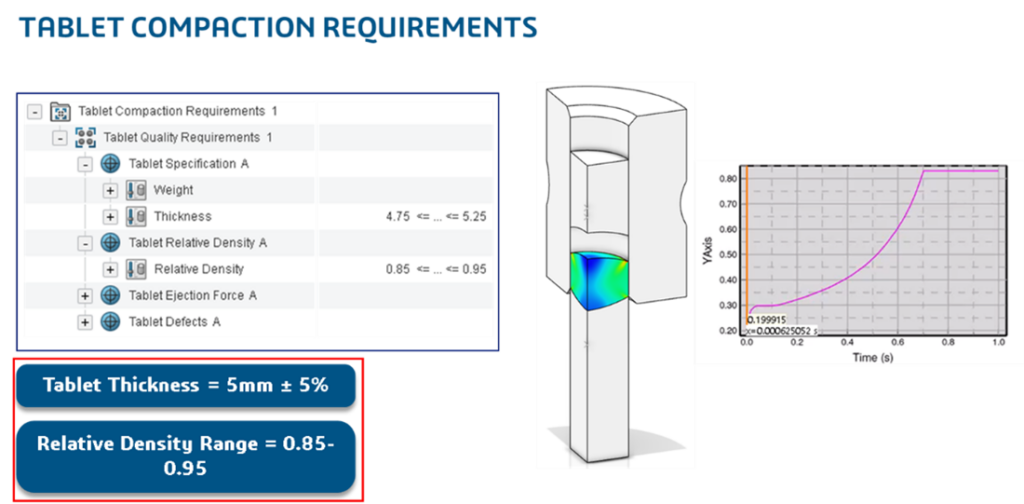
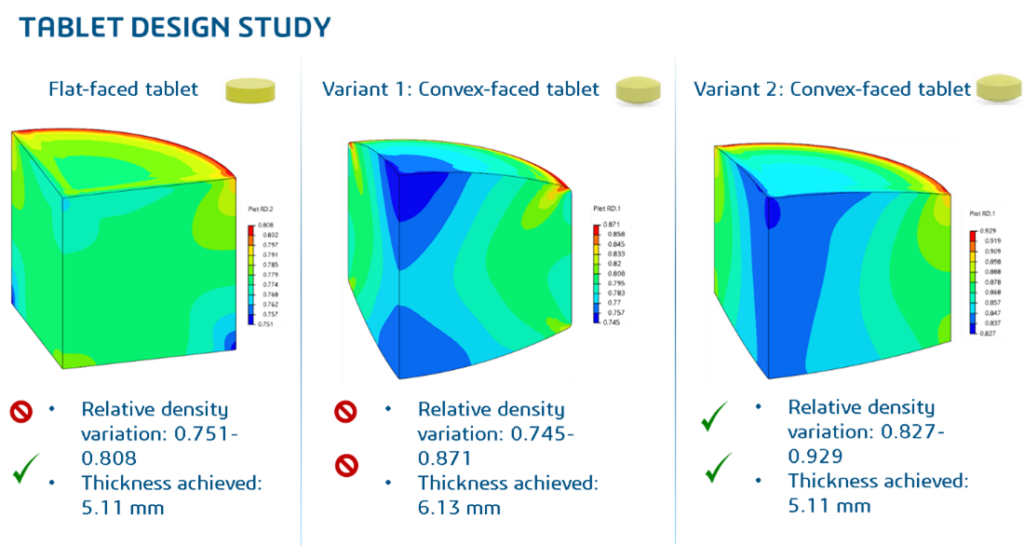
To see this workflow in action, let us look at a case study comparing three different tablet geometry variants designed to meet a strict thickness and relative density target. The relative density is crucial; if it is too low, the tablet will chip, but if the density distribution is non-uniform, it may stick or cap.
| Tablet Design Variant | Geometry Type | Relative Density Achieved | Thickness Target Met? | Manufacturing Risk / Verdict |
| Flat-Faced | Flat surfaces | 0.751 (Low) | Yes | High risk of edge chipping during ejection. Rejected. |
| Convex Variant 1 | High convexity | Non-uniform distribution | No | High risk of sticking in the center. Rejected. |
| Convex Variant 2 | Optimized low convexity | Uniform distribution | Yes | Excellent compaction, low defect risk. Approved. |
As the simulation results show, the flat-faced tablet met the thickness requirement but suffered from low relative density, risking edge chipping. Convex Variant 1 had too much curvature, leading to non-uniform density in the center and a high risk of sticking. Only Convex Variant 2—with its optimized, reduced convexity—achieved both uniform density and the correct thickness, proving to be the most manufacturable design.
The transition from physical compaction testing to virtual twins is a game-changer for the pharmaceutical sector. By adopting a unified SOLIDWORKS and 3DEXPERIENCE MODSIM workflow, companies can drastically compress their development timelines, protect precious active ingredients, and get personalized therapies to market faster.
For a deeper dive into how unified modeling and simulation is transforming other highly regulated industries, check out the official Dassault Systèmes SIMULIA Blog.
Are you ready to break down the silos between your design and simulation teams? How could a unified MODSIM workflow change your current product development cycle? Let us know in the comments below!